












Keywords
State
Church
Subjectivity
Categories
How to Cite




Abstract
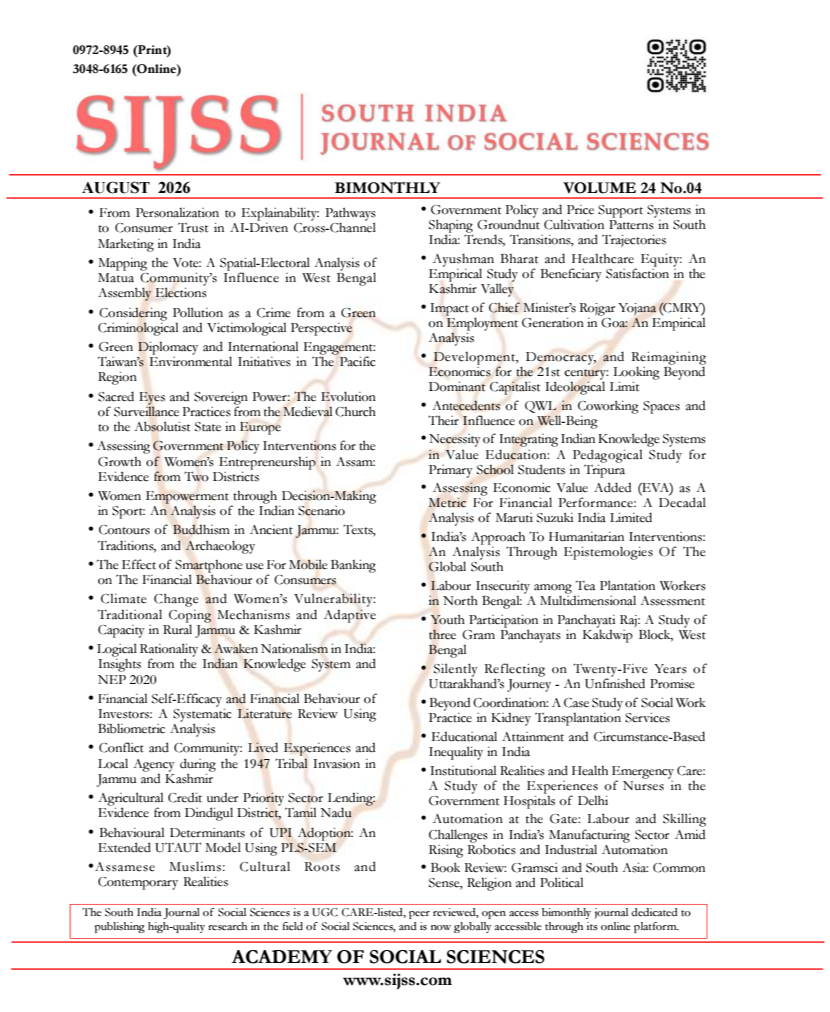
The article aims to understand the historical evolution of surveillance practices. It will be argued that surveillance is not a recent phenomenon; it has existed since antiquity. Using the genealogical analysis method articulated by the well-known French thinker Michel Foucault, the article will analyze the nature, scope, and functioning of surveillance practices during the medieval era of the Christian church and later during the formative phase of the absolutist state. It has been argued that the social function of surveillance apparatuses differed- the surveillance apparatus of the Church aimed at the salvation of the soul, whereas the surveillance mechanisms of the absolutist state were geared to protect the territory of the state.
References
1. Anderson, P. (1974). Lineages of the absolutist state (p. 27). Verso.
2. Branch, J. (2011). Mapping the sovereign state: Technology, authority, and systemic change. International Organization, 65(1), 1–36. http://www.jstor.org/stable/23016102
3. Dandeker, C. (1990). Surveillance, power and modernity: Bureaucracy and discipline from 1700 to the present day (p. 81). Polity Press.
4. Elden, S. (2013). The birth of territory (pp. 323–324). University of Chicago Press.
5. Foucault, M. (2009). Security, territory, population: Lectures at the Collège de France, 1977–1978 (G. Burchell, Trans., p. 128). Palgrave Macmillan.
6. Foucault, M. (2016). About the beginning of the hermeneutics of the soul: Lectures at Dartmouth College, 1980 (G. Burchell, Trans., p. 54). University of Chicago Press.
7. Fuchs, C. (2010, October 1). How can surveillance be defined? Remarks on theoretical foundations of surveillance studies (The Internet & Surveillance Research Paper Series, No. 1, p. 6).
8. Giddens, A. (1985). The nation-state and violence: Volume 2 of a contemporary critique of historical materialism (pp. 179–180). Polity Press.
9. Gratton, P. (2012). The state of sovereignty: Lessons from the political fiction of modernity (p. 122). State University of New York Press.
10. Gros, F. (2014). The fourth age of security. In V. Lemm & M. Vatter (Eds.), The government of life: Foucault, biopolitics, and neoliberalism (p. 20). Fordham University Press.
11. Helmholz, R. H. (2015). Jurisdiction and discipline. In R. N. Swanson (Ed.), The Routledge history of medieval Christianity 1050–1500 (pp. 452–453).
12. Landry, J.-M. (2009, Spring). Confession, obedience, and subjectivity: Michel Foucault’s unpublished lectures on the government of the living. Telos, (pp. 121–122). https://www.academia.edu/1797532/Confession_Obedience_and_Subjectivity_Michel_Foucault_s_Unpublished_Lectures_On_the_Government_of_the_Living.
13. Lyon, D. (n.d.). Surveillance, power and everyday life (p. 2). https://panoptykon.org/sites/default/files/FeedsEnclosure-oxford_handbook_3.pdf.
14. Marx, G. T. (2016). Windows into the soul: Surveillance and technology in an age of high technology (p. xii). University of Chicago Press.
15. Opello, W. C., & Rosow, S. J. (1999). The nation-state and global order: A historical introduction to contemporary politics (p. 49). Lynne Rienner Publishers.
16. Power, A. (2014, Winter). Under the watchful eye. Lapham Quarterly, 7(1). http://www.laphamsquarterly.org/spies/under-watchful-eyes
17. Zurcher, A. (2013, November 1). Roman Empire to the NSA: A world history of government spying. BBC News. http://www.bbc.com/news/magazine-24749166

This work is licensed under a Creative Commons Attribution-NonCommercial-NoDerivatives 4.0 International License.
Copyright (c) 2026 South India Journal of Social Sciences