













Keywords
Indian Administrative Service (IAS)
Indian Civil Service (ICS)
Indian National Congress
Political Parties
How to Cite




Abstract
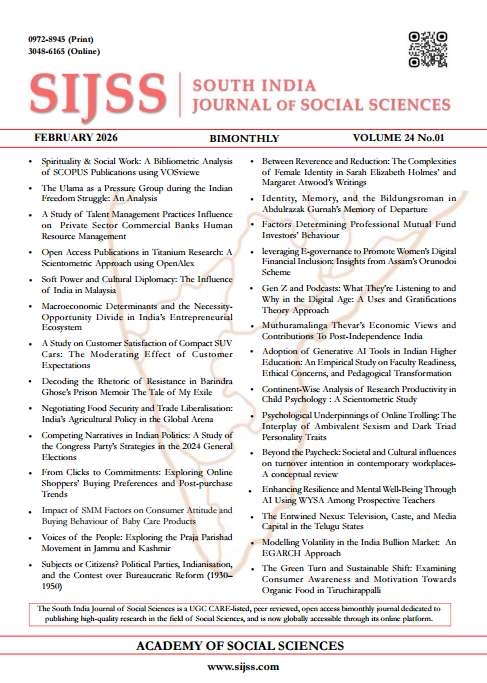
This paper examines the role of political parties in reshaping the Indian Civil Service (ICS) between 1930 and 1950, situating bureaucratic reform within the larger context of nationalist politics and decolonization. It argues that while democratic structures were adopted after independence, administrative social relations persisted, creating a distinctive administrative service where citizens are treated more as subjects. The paper explores the historical roots of the interaction between administrative services and political parties practice across pre- and post- independence era. To understand the critical dimensions, of political party theories of democracy within the Indian Administration Service (IAS), it is essential to focus on changing guidelines, spending patterns, and assessment evaluations over the years. The Indian National Congress and the Forward Bloc’s determination made Indianisation a symbol of imperial domination and an obstacle to representative governance. Thus, survival of Indianisation became a wider struggle over sovereignty and legitimacy in a decolonizing polity. The paper analysis that ICS serves as a microcosm of larger challenges in India’s journey from a colonial subject-based system to participatory democracy. It calls for fundamental reforms in how development schemes are conceived, implemented and evaluated to achieve meaningful democratic self-governance. The paper concludes that gradual transformation of the ICS into IAS in 1950 did not merely signify administrative continuity but embodied the negotiated outcome of these political struggles. It stipulate fundamental reforms in how developmental schemes are conceived, implemented and evaluated to achieve meaningful citizen empowerment and democratic governance.
References
1. Amrita Bazar Patrika. (1937, August 3). Amrita Bazar Patrika.
2. Arnold, D. (1986). Police power and colonial rule: Madras, 1859–1947. Oxford University Press.
3. Basu, D. D. (2013). An introduction to the Constitution of India (21st ed.). LexisNexis.
4. Bose, S., & Jalal, A. (2017). Modern South Asia: History, culture, political economy (4thed.). Routledge. https://doi.org/10.4324/9781315229620
5. Brass, P. (1990). The politics of India since independence. Cambridge University Press.
6. Chandra, B., Mukherjee, M., Mukherjee, A., Panikkar, K. N., & Mahajan, S. (1989). India’s struggle for independence, 1857–1947. Penguin Books India.
7. Constituent Assembly Debates. (1946). ConstituentAssembly Debates (Vol. II, November 10). Government of India.
8. Constituent Assembly Debates. (1948). ConstituentAssembly Debates (Vol. IX, November). Government of India.
9. Constituent Assembly Debates. (1949). ConstituentAssembly Debates (Vol. XI, October 10). Government of India.
10. Gandhi, M. K. (1934, July 20). Harijan.
11. Hindustan Times. (1947, August 21). Hindustan Times.
12. Kothari, R. (1970). Politics in India. Orient Longman.
13. Mansergh, N. (Ed.). (1983). The transfer of power, 1942–7 (Vol. XII). HMSO.
14. Menon, V. P. (1957). The transfer of power in India. Orient Longman.
15. Misra, B. B. (1978). The Indian administrative service in British India. Oxford University Press.
16. National Herald. (1949, June 14). National Herald.
17. Nehru, J. (1975). Selected works of Jawaharlal Nehru (Vol. 8). Jawaharlal Nehru Memorial Fund.
18. Parliament of India. (1951). Lok Sabha Debates (Vol. 2). Parliament of India.
19. Report of the Punjab Disturbances of 1947. (1948). Government of India.
20. Weiner, M. (1967). Party politics in India. Princeton University Press.
21. Report of the Royal Commission on the Superior Civil Services in India, Government of India, 1924.
22. Bipan Chandra, Mridula Mukherjee, Aditya Mukherjee, Sucheta Mahajan, and K. N. Panikkar, India’s Struggle for Independence, 1857–1947 (Penguin Books, 1989), 245.

This work is licensed under a Creative Commons Attribution-NonCommercial-NoDerivatives 4.0 International License.
Copyright (c) 2026 South India Journal of Social Sciences