












Keywords
Social Protest
Contestation
Caste
Hegemony
How to Cite




Abstract
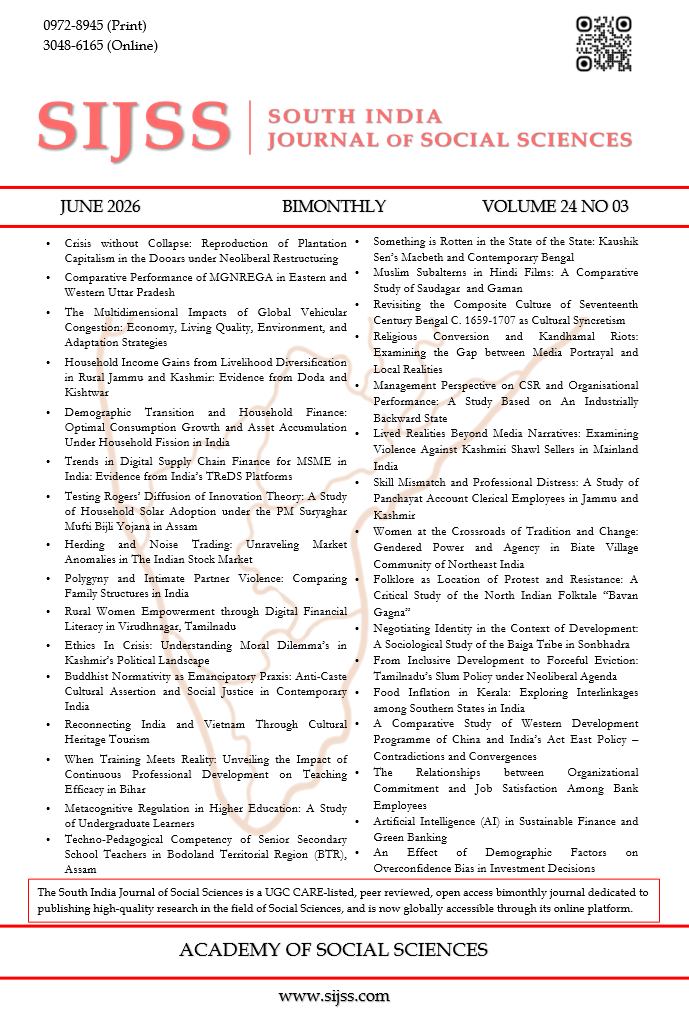
Folklore, as generally understood, is related to common people and is construed in relation to higher/literate culture. This relation with popular culture gives a dimension of resistance and critique to the folk culture where stories, proverbs, sayings, etc, apart from being condensed wisdom also become an expression of resistance and protests against the dominant/hegemonic culture. Folklore records the real life of the common people with uncomfortable fidelity which also reflects their protest against authority or existing social structures sometimes directly, sometimes indirectly. This paper, through a critical and careful analysis of a folktale titled ‘Bavan Gagna’ will try to identify central themes on the subject of caste and gender and correlate them with similar ideas and concepts found in religious/philosophical movements, especially with the Bhakti Movement in north India.
References
1. Bascom, William R. (1954). "Four Functions of Folklore.” The Journal of American Folklore, 67 (266) pp. 333-349.
2. Bhaduri, Saugata. (2006). “The Ideology of Discourse in the Folk Sacred Space: Potentialising subversion in the Vrata-Katha tradition of Bengal.” In M. D. Muthukumaraswamy (2006), (Eds.) Folklore as Discourse, National Folklore Support Centre, Chennai, pp. 191- 196.
3. Channa, Subhadra Mitra. (2021). “Negotiating Hierarchies Through Symbolic Praxis.” In Biswajit Das and Debendra Prasad Majhi, (2021), (Eds.), Caste, Communication And Power, Sage, New Delhi, pp. 103-120
4. Choudhury, Pranab Chandra Roy. (1968). Folk Tales of Bihar, Sahitya Akademi, New Delhi
5. Dundes, Alan. (1969). “Folklore as a Mirror of Culture.” Elementary English, Vol. 46, No. 4, pp. 471-482.
6. Goswami, Praphulladatta. (1985). “Social Criticism in Assamese Tale.” In Soumen Sen (1985), (Eds.), Folklore in North-East India, Om Songs Publications, New Delhi
7. Hess, Linda, and Sukhdeo Singh. (2002). The Bijak of Kabir, Oxford University Press, New York
8. Islam, Mazharul. (1985). Folklore: The Pulse of The People, Concept Publishing Company, New Delhi
9. Lessa, Iara. (2005). "Discursive Struggles Within Social Welfare: Restaging Teen Motherhood." British Journal of Social Work, Vol. 36, No 2, pp. 283-298.
10. Limon, Jose E. (1983). "Western Marxism and Folklore: A critical introduction." The Journal of American Folklore, Vol. 96, No. 379, pp. 34-52.
11. Lo, Cheikh Tidiane. (2021). "Political Protest, Ideology, and Social Criticism in Wolof Folk Poetry." In Solimar Otero and Mintzi Auanda Martinez-Rivera, (2021), (Eds.), Theorizing Folklore From the Margins: Critical and Ethical Approaches, Indian University Press, Indiana, pp. 113-130
12. Lombardi-Satriani, Luigi. (1974). "Folklore as Culture of Contestation." Journal of the Folklore Institute, Vol. 11, No. 1/2, Special Issue: Folklore Studies in Italy, pp. 99-121.
13. Mojares, Resil B. (2002). Waiting for Mariang Makiling: Essays in Philippine Cultural History, Ateneo De Manila University Press, Manila
14. Narayan, Badri. (2010). "Memory and Social Protest ." Bernard Bel, Jan Brouwer, Biswajit Das, Vibodh Parthasarathi and Guy Poitevin (2010), (Eds,.), In Communication, Culture And Confrontation, Sage, New Delhi, pp. 157-177
15. Pathak, Dev Nath. (2021). “Communicating the Contestation of Caste: In Between Folklore and Modern Literature in Mithala.” In Biswajit Das and Debendra Prasad Majhi Majhi, (2021), (Eds.), Caste Communication And Power, Sage, New Delhi, pp. 137-151
16. Santos, Boaventura de Sousa. (2018). The End of the Cognitive Empire: The Coming of Age of Epistemologies of the South. Durham: Duke University Press.
17. Singh, Neerja, and Namit Vikram Singh. (2021). “Popular Culture and Social Movements: A Caste Based Narrative.” In Biswajit Das and Debendra Prasad Majhi Majhi, (2021), (Eds.), Caste, Communication And Power, Sage, New Delhi, pp. 121-136
18. Verma, Vinod. (2017). “Pilgrimage Upside-Down: Kabir Ulatbansi Pilgrim.” International Journal of Religious Tourism and Pilgrimage, Vol. 5: Issue. 2, pp. 43-49.
19. Wang, Betty. (1965). “Folksongs as Regulators of Politics.” In Alan Dundes, (1965), (Eds.) The Study of Folklore, Prentice-Hall, New Jersey, pp. 308-313

This work is licensed under a Creative Commons Attribution-NonCommercial-NoDerivatives 4.0 International License.
Copyright (c) 2026 South India Journal of Social Sciences