













Keywords
Sanitation workers
scavengers
How to Cite




Abstract
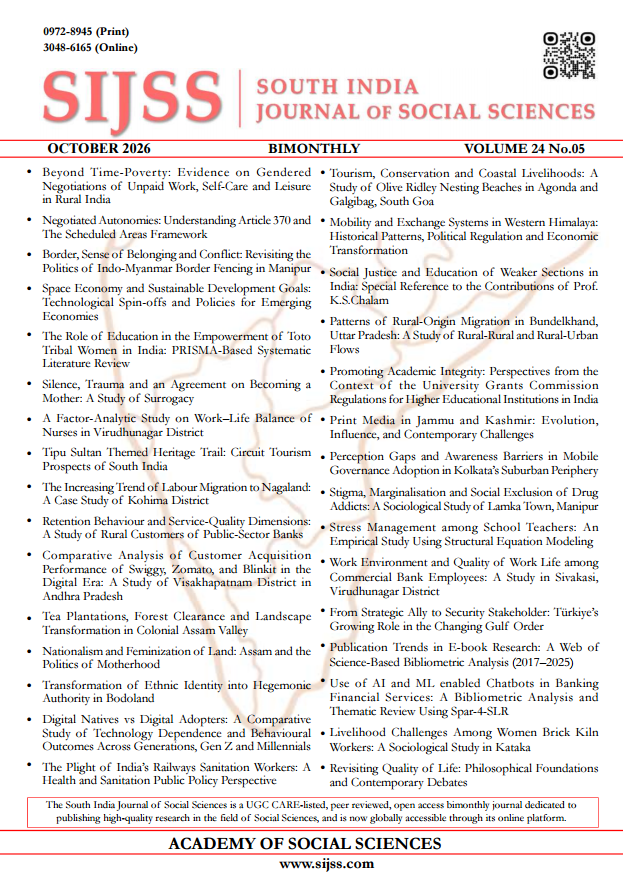
India remains a caste-based society, and communities are categorised based on caste identity and their socio-cultural position rather than the physical labour of individuals. The sanitation workers play a critical role in cleaning and maintaining the environment, but the systemic marginalisation continues through the static framework of varna. The discriminatory mindset that perpetuates the dominance of social relations. Across the Indian subcontinent, these legacy caste communities are reduced to sanitation work, which includes the disposal of both human and animal waste manually. The removal of decomposing animal carcasses and the hazardous manual cleaning of public and private latrines and sewers.
Undeniably, this informal sector provides indispensable environmental, public health, and sanitation services to urban centres across India. Yet, despite their vital contributions, these waste pickers, scavengers, and informal urbanizers remain acutely marginalised—socially, economically, and politically. Against this backdrop, this article examines the key challenges confronting unorganised sanitation workers and scavengers at the New Delhi Railway Station (NDLS) and assesses the effectiveness of some policies formulated for their protection and security.
References
1. Amit, K. (2026). How the Swachh Bharat Mission fails to capture the reality of untreated sewage and deadly sanitation labour. Economic and Political Weekly, 64(15).
2. Chaplin, S. E. (1999). Cities, sewers and poverty: India’s politics of sanitation. Environment and Urbanisation, 11(1), 145–158. https://doi.org/10.1177/095624789901100112
3. Cullet, P., & Bhullar, L. (Eds.). (2015). Sanitation law and policy in India: An introduction to basic instruments. Oxford University Press.
4. Dahiya, R. (2020). Eradication of the inhuman practice of manual scavenging in Tamil Nadu: Is it possible? International Journal of Law Management & Humanities, 3(5), 756–764.
5. Dalberg. (n.d.). Understanding Indian sanitation workers and finding solutions to their challenges. https://dalberg.com/our_ideas/understanding-indian-sanitation-workers-and-finding-solutions-their-challenges
6. Indian Railways Health and Malaria Inspector’s Association. (n.d.). Memorandum of representation submitted before the Central Pay Commission. New Delhi.
7. Jain, P. S. (2024). India's national sanitation policies: Evaluation, impact and recommendations. Asia-Pacific Journal of Rural Development. Advance online publication. https://doi.org/10.1177/1018529124xxxxxx
8. Jain, R. (2021). Sewage treatment in Indian cities. [Publisher/Report Name Missing].
9. Kumar, S. R. (2018). A case study of Sulabh International Social Service [Case study]. Indian Institute of Management Ahmedabad.
10. Ministry of Drinking Water and Sanitation. (2014). Guidelines for Swachh Bharat Mission (Gramin) (pp. 1–3). Government of India.
11. Modie, A. D. (Ed.). (1990). The concept of work in Indian society. Indian Institute of Advanced Study; Manohar Publications.
12. Pathak, B. (1991). Sulabh International Museum of Toilets. Sulabh International.
13. Sharma, M. (2017). Caste and nature: Dalits and Indian environmental politics. Oxford University Press.
14. Shinoda, T. (2005). Marginalisation in the midst of modernisation: A study of sweepers in Western India. Manohar Publishers.
15. Sriraman, T. (2014). [Chapter title missing]. In N. Menon, A. Nigam, & S. Palshikar (Eds.), Critical studies in politics: Exploring sites, selves, power. Orient Blackswan.
16. Sylvester, C. (1999). Development studies and postcolonial studies: Disparate tales of “the Third World.” Third World Quarterly, 20(4), 703–721. https://doi.org/10.1080/01436599975404
17. Thekaekara, M. M. (2002). Endless filth: The saga of the Bhangis. Books for Change.

This work is licensed under a Creative Commons Attribution-NonCommercial-NoDerivatives 4.0 International License.
Copyright (c) 2026 South India Journal of Social Sciences