












Keywords
Political Society
Categories
How to Cite




Abstract
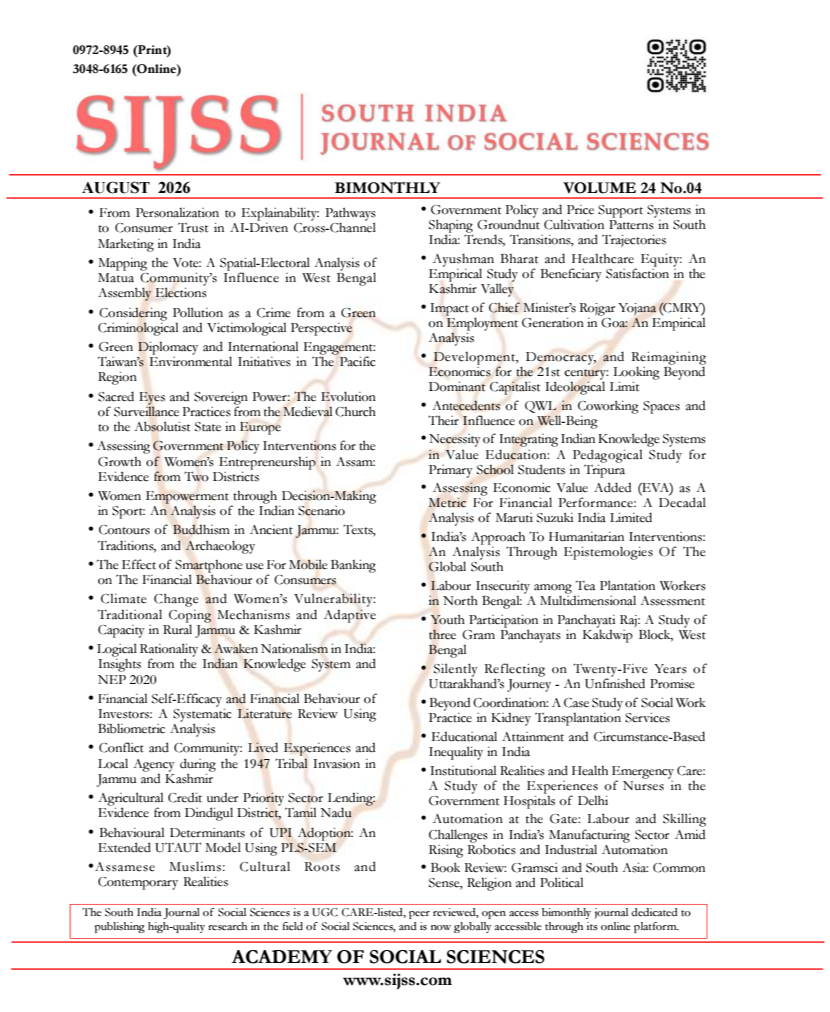
In Gramsci and South Asia, Arun Kumar Patnaik undertakes an ambitious methodological and sociological project: the decolonization of Antonio Gramsci’s theoretical framework to analyze the specific historical and cultural contours of post-colonial India. By navigating between what he terms “empty concepts” (universal boundaries) and “filled concepts” (historical specificities), Patnaik attempts to bridge the gap between Western Marxist theory and the South Asian social imaginary. While the book offers a sophisticated defense of “dialogic” secularism, it is difficult to reconcile the pursuit of an assimilationist route with the need to be attentive to the radical specificity of subaltern claims and deep-seated structural asymmetries of power.
References
1. Banerjee, S. (1989). The parlour and the streets: Elite and popular culture in nineteenth century Calcutta. Seagull Books.
2. Bhaumik, S. (2019). Understanding the Religious Worlds of the Subalterns: An Analysis of Syncretic Culture in Bengal. Summerhill IIAS Review, 25(2), 38–44.
3. Fanon, F. (2008). Black skin, white masks (R. Philcox, Trans.). Grove Press. (Original work published 1952)
4. Guru, G. (2013). Limits of the organic intellectual: A Gramscian reading of Ambedkar. In C. Zene (Ed.), The political philosophies of Antonio Gramsci and B. R. Ambedkar: Itineraries of Dalits and subalterns. Routledge.
5. Hall, S. (1979). The great moving right show. Marxism Today, 23(1), 14–20.
6. Kapur, R. (2024). The Ayodhya case, freedom of religion, and the making of modernist ‘Hinduism’. Contemporary South Asia, 32(1), 10–25. https://doi.org/10.1080/09584935.2023.2227127
7. Nainar, V., & Uma, S. (2011). Waiting for justice: A report of National People’s Tribunal on Kandhamal. National Solidarity Forum.
8. Patnaik, A. K. (2025). Gramsci and South Asia: Common sense, religion and political society. Routledge.
9. Povinelli, E. A. (2002). The cunning of recognition: Indigenous alterities and the making of Australian multiculturalism. Duke University Press.
10. Roy, A. (1983). The Islamic syncretistic tradition in Bengal. Princeton University Press.
11. United States Commission on International Religious Freedom. (2009). Annual report of the United States Commission on International Religious Freedom. https://www.uscirf.gov
12. Urban, H. B. (1999). The politics of madness: The construction and manipulation of the ‘Baul’ image in modern Bengal. South Asia: Journal of South Asian Studies, 22(1), 13–46. https://doi.org/10.1080/00856409908723358

This work is licensed under a Creative Commons Attribution-NonCommercial-NoDerivatives 4.0 International License.
Copyright (c) 2026 South India Journal of Social Sciences