













Keywords
Film Studies
Dalit
Minority women
Bengali cinema
male gaze
How to Cite




Abstract
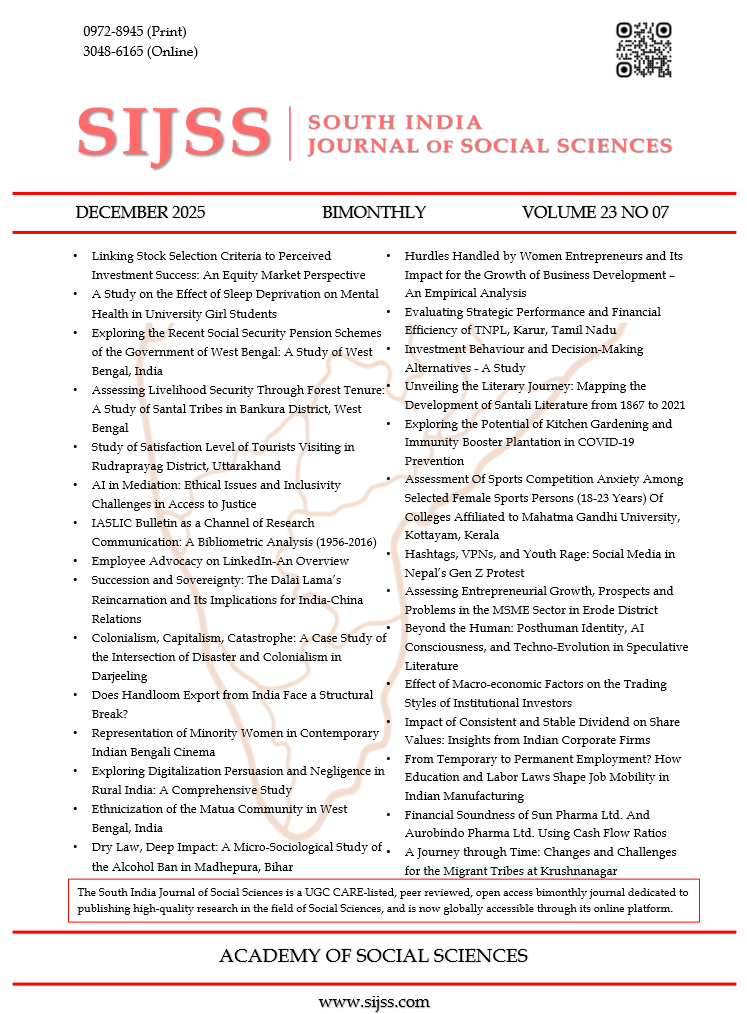
This study argues that Indian Bengali cinema prominently reinforces patriarchal and stereotypical images of minority women -- especially Muslim, Dalit, Christian, etc. -- by marginalising or symbolically erasing them within stories. It uncovers a consistent trend, shared with Bollywood and other global industries, where minority women are mainly cast in underrepresented or stereotypical supporting roles. Unlike other regional cinemas, which have attracted attention, portrayals of minority women in Indian Bengali cinema have largely been disregarded. To address this gap, this research systematically investigates such representations using feminist theory, focusing on narrative analysis, to reveal how gender biases and socio-cultural factors shape these films. Through an in-depth analysis of selected films from 2015 to 2020, the study foregrounds the ongoing symbolic erasure of minority women by critically examining how gendered depictions persist. Taking two films as case studies -- Srijit Mukherjee’s Rajkahini (2015) and Birsa Dasgupta’s Crisscross (2018) – the article scrutinises the narrative roles assigned to minority women and their interactions with prevailing cultural ideologies.
References
1. Agarwal, R. (2014). Changing roles of women in Indian cinema. Silpakorn University Journal of Social Sciences, Humanities, and Arts, 14(2), 145–160. http://www.academia.edu/8758726/Changing_Roles_of_Women_in_Indian_Cinema
2. Ahmad, I., & Siddiqui, M. Z. (2017). Democracy in Jail: Over-representation of Minorities in Indian Prisons. Economic and Political Weekly, 52(44), 98–106. http://www.jstor.org/stable/26697627
3. Atwal, J. (2018). Embodiment of Untouchability: Cinematic Representations of the “Low” Caste Women in India. 2(1), 735-745. https://doi.org/10.1515/CULTURE-2018-0066.
4. Ayuningtyas, Shafira., & Merdeka, Pita. (2021). Orcs Lives Matter: Representation of African Americans in Bright Film. Insaniyat: Journal of Islam and Humanities. 5, 105–117. DOI: 10.15408/insaniyat.v5i2.20824.
5. Basu, A., & Tripathi, P. (2023). In Search of Redemption: Approaching Dalit Masculinities in Article 15 (2019) and Jai Bhim (2021).
6. Bose, A., & Singh, A. K. (2022). Geeli Pucchi.QED: A Journal of GLBTQ Worldmaking,9(2), 184–187. https://doi.org/10.14321/qed.9.issue-2.0184.
7. Chaudhuri, M. (2013). Vision of Tagore through Applicability in the Spectrum of Ray and Ghosh: Reflection of Feminine Approach in two Bengali Movies. Media Watch, 4(1), 40-51. https://www.indianjournals.com/article/mw-4-1-003
8. Dasgupta, Birsa, director. Crisscross. Shree Venkatesh Films, 2018. 1 hr., 53 min. https://www.hoichoi.tv/films/title/crisscross.
9. Datta, S. (2000). Globalisation and Representations of Women in Indian Cinema. Social Scientist, 28(3/4), 71-82. https://doi.org/10.2307/3518191.
10. Guha, S. (2024). Passive to Progressive Representation of Three Female Characters in the Movies of Satyajit Ray. International Journal of Science and Research. https://doi.org/10.21275/sr24105132206.
11. Hivale, G. T. (2023). Caste, Class and Gender Representation in Jai Bhim Film. International Journal of Science and Research, 12(10), 651–654. https://doi.org/10.21275/sr231006154446.
12. Hussain, I., Ali, S., & Gardezi, S. A. A. (2023). Illustration of Religious Minority Symbols in Bollywood Films: A Descriptive & Semiotic Approach. Global Digital & Print Media Review, VI(I), 151–165. https://doi.org/10.31703/gdpmr.2023(VI-I).13.
13. Hussein, N., & Hussain, S. (2015). Interrogating Practices of Gender, Religion and Nationalism in the Representation of Muslim Women in Bollywood: Contexts of Change, Sites of Continuity. Exchanges: The Warwick Research Journal, 2(2), 284–304. https://doi.org/10.31273/EIRJ.V2I2.117.
14. Klinger, B. (2012). “Cinema/ideology/criticism” revisited: the progressive genre. In Film genre reader IV (pp. 93-109). University of Texas Press.
15. Kamble, C., & Biswal, S. K. (2023). The Changing Role of Marginalised Women in Hindi Cinema: A Shift from Cinematic Negotiations to Empowerment. Media Watch, 14 (3), 386–402. https://doi.org/10.1177/09760911231191266
16. Lalitha, S., & Pankaj, A. K. (2022). Dalit Women in Cinema: A Narrative of Gender and Caste. The American Journal of Economics and Sociology,81(1), 143–157. https://doi.org/10.1111/ajes.12448.
17. Mamta. (2017). Portrayal of Dalit Women in Hindi Cinema. The Criterion: An International Journal in English. https://www.academia.edu/43353471/Portrayal_of_Dalit_Women_in_Hindi_Cinema.
18. Mithuna, S. M. (2023). Re-assessing the Classic Frames: Intersection of Caste, Class and Gender in Neelakuyil.Contemporary Voice of Dalit. https://doi.org/10.1177/2455328x231186470.
19. Mukherji, Srijit, director. Rajkahini. Shree Venkatesh Films, 2015. 2 hrs., 40 min. https://www.hoichoi.tv/films/title/rajkahini.
20. Mukherjee, S. (2016). Women and Resistance in Contemporary Bengali Cinema: A Freedom Incomplete. https://doi.org/10.4324/9781315651392.
21. Mukherjee, Abhik (2022). Sex Positivity of Satyajit Ray’s Women: Their Cinematic Journey Towards the Ancient Indian Heritage. SAGE Open, 12.
22. Mulvey, L. (1989). Visual and Other Pleasures. Palgrave Macmillan, London.
23. Nadamala, B. S., & Tripathi, P. (2024). Towards Inclusivity: Dalit Women’s Representation in Contemporary Telugu Cinescapes. https://doi.org/10.1177/01417789241250296.
24. Omi, M. (2022). In living color: Race and American culture. In Cultural politics in contemporary America (pp. 111-122). Routledge.
25. Prasitha, V., & Bhuvaneswari, G. (2024). The Caste Continuum: Intersectional Identities and Visual Metaphors in Geeli Pucchi. International Research Journal of Multidisciplinary Scope. https://doi.org/10.47857/irjms.2024.v05i04.01473
26. Rane, S., & Chowdhary, S. R. (2023). Unveiling the male gaze in Bollywood movies: Deconstructing objectification and stereotyping in Hindi cinema. Shodak: A Journal of Historical Research, 52(2), 256-263.
27. Sharma, A., & Biloria, D. (2025). Understanding Social Influences in Cinema Managing Culture, Society, and Peer Influence. In Audience Sociology and Consumer Behavior in the Film Industry (pp. 213-232). IGI Global Scientific Publishing.
28. Simon, R., & Hasan, S. (2025). Patriarchy and Gender Inequality: A Comprehensive Analysis of Women’s Empowerment in Contemporary India. Gender Issues, 42(1), 7.
29. Singh, A. (2022). The Construction and Representation of Lower-Caste Women in Bollywood Films (pp. 163–174). Routledge eBooks. https://doi.org/10.4324/9781003343578-17.
30. Spivak, G. C. (1988). Can the subaltern speak? Marxism and the Interpretation of Culture. C. Nelson and L. Grossberg. Urbana. University of Illinois Press. Pp. 271-313.
31. Spivak, G. C. (2000). ‘Forward’: In A Companion to Postcolonial Studies, ed. Henry Schwartz and Sangeeta Ray (15–17). USA, UK, Australia: Oxford, Blackwell Publishing Limited.
32. Spivak, G.C. (2010). Can the Subaltern Speak? Republished in Rosalind Morris (Ed.). Reflections on the History of an Idea. New York: Columbia University Press. Pp. 21–80.
33. TOI (2022, January 31). Bengali films which broke gender stereotypes. timesofindia.indiatimes.com. https://timesofindia.indiatimes.com/entertainment/bengali/movies/news/bengali-films-which-broke-gender-stereotypes/photostory/67770536.cms.
34. Tokatli, C. (2022). Dalit Representation in Hindi Cinema 1(pp. 17–31). Routledge eBooks. https://doi.org/10.4324/9781003343578-4.
35. Wright, S. (2010). Visible Minorities, Invisible Citizens: Minority Representation in the French Media. In Bhaumik, Subir. (Ed). Counter-Gaze: Media, Migrants, Minorities (pp. 30–38). Sadhana Press Private Limited.
36. Zafar, S., & Batta. A. (2017). Liberalisation and Changing Representation of Women in Hindi Cinema. Indian Journal of Science and Technology, 10(46), 1–8. https://doi.org/10.17485/ijst/2017/v10i46/115859.

This work is licensed under a Creative Commons Attribution-NonCommercial-NoDerivatives 4.0 International License.
Copyright (c) 2025 South India Journal of Social Sciences