













Keywords
Institutional Investors
Trading Style
Momentum-Contrarian
Buy Ratio
Logistic Regression
How to Cite




Abstract
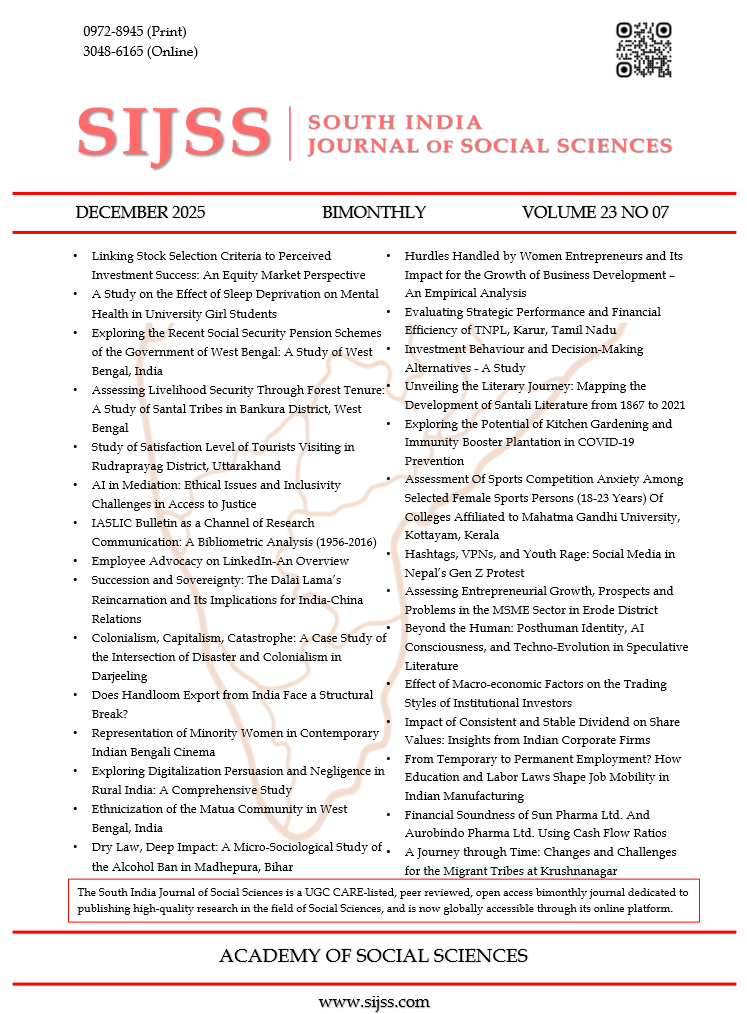
Institutional investors, known for their professional expertise and high-volume trading, vary in their investment horizons and strategies, particularly in how they respond to macro-economic factors.This study investigates whether foreign institutional investors(FIIs) and domestic institutional investors (DIIs) in India adopt different trading styles in relation to macro-economic factors, with a particular focus on momentum and contrarian trading. The study uses the monthly aggregated investment flows of institutional investors in the equity market to measure the trading style from 1st April 2012 to 31st March 2024. The trading style of institutional investors is measured using the Buy Ratio. Further to determine which macro-economic factors increase the likelihood of institutional investors going momentum or contrarian is examined using the logistic regression model. The findings show institutional investors do not mimic each other trading style with respect to macro-economic announcements. The results reveal that there exist significant positive and negative relations between a few macro-economic factors and institutional investors. The study finds evidence that FIIs chase the market return and pursue a momentum trading style while DIIs adopt a contrarian trading style.
References
1. Agarwal, R. N. (1997). Foreign portfolio investment in some developing countries: a study of determinants and macro-economic impact. Indian Economic Review, 32(2), 217–229. http://www.jstor.org/stable/29794138
2. Arora, R. K. (2016). The relation between investment of domestic and foreign institutional investors and stock returns in India. Global Business Review, 17(3), 654–664. https://doi.org/10.1177/0972150916630830
3. Bansal, P. K. (2021). Critical study of Indian stock market relationship with domestic (DIIs) and foreign institutional investors (FIIs). Materials Today: Pro-ceedings, 37, 2837–2843. https://doi.org/10.1016/j.matpr.2020.08.658
4. Chakrabarti, R. (2001). FII flows to India: Nature and causes. Money and Finance, 2(7), 1-30.
5. Chandra, A. (2012). Cause and effect between FII trad-ing behaviour and stock market returns: The Indian ex-perience. Journal of Indian Business Research, 4(4), 286–300. https://doi.org/10.1108/17554191211274794
6. Che, L. (2018). Investor types and stock return volatili-ty. Journal of Empirical Finance, 47, 139–161. https://doi.org/10.1016/j.jempfin.2018.03.005
7. Chhimwal, B., & Bapat, V. (2021). Comparative Study of Momentum and Contrarian Behavior of Dif-ferent Investors: Evidence from the Indian Market. Asia-Pacific Financial Markets, 28(1), 19–53. https://doi.org/10.1007/s10690-020-09315-3
8. Dhingra, V. S., Gandhi, S., & Bulsara, H. P. (2016). Foreign institutional investments in India: An empiri-cal analysis of dynamic interactions with stock market return and volatility. IIMB Management Review, 28(4), 212–224. https://doi.org/10.1016/j.iimb.2016.10.001
9. Garg, R., & Dua, P. (2014). Foreign Portfolio Invest-ment Flows to India: Determinants and Analysis. World Development, 59, 16–28.
10. Geoffrey Booth, G., Kallunki, J. P., Sahlström, P., & Tyynelä, J. (2011). Foreign vs domestic investors and the post-announcement drift. International Journal of Managerial Finance, 7(3), 220–237. https://doi.org/10.1108/17439131111144441
11. Grinblatt, M., & Keloharju, M. (2000). The invest-ment behavior and performance of various investor types: a study of Finland’s unique data set. Journal of Financial Economics, 55(1), 43–67. https://doi.org/10.1016/S0304-405X(99)00044-6
12. Jegadeesh, N., & Titman, S. (1993). Returns to buying winners and selling losers: Implications for stock mar-ket efficiency. The Journal of finance, 48(1), 65-91.
13. Kumari, M., Bhattacharjee, A., Debnath, P., & Das, J. (2023). Investigating the Determinants of Foreign Insti-tutional Investor Inflows in Indian Equity Market: An Application of the Augmented Autoregressive Distrib-uted Lag Bounds Testing Approach. The Indian Eco-nomic Journal, 71(5), 805–819. https://doi.org/10.1177/00194662231186559
14. Mukherjee, P., Bose, S., & Coondoo, D. (2002). Foreign institutional investment in the Indian eq-uity market: An analysis of daily flows during January 1999-May 2002. Money & Finance, 2(9-10), 21-50.
15. Nofsinger, J. R. (2001). The impact of public in-formation on investors. Journal of Banking & Finance, 25(7), 1339–1366. https://doi.org/10.1016/S0378-4266(00)00133-3
16. Rai, K., & Bhanumurthy, N. (2004). Determi-nants of foreign institutional investment in India: The role of return, risk, and inflation. The Devel-oping Economies, 42, 479–493. https://doi.org/10.1111/j.1746-1049.2004.tb00246.x
17. Hymer, S. H. (1960). The international opera-tions of national firms, a study of direct foreign investment (Doctoral dissertation, Massachusetts Institute of Technology).

This work is licensed under a Creative Commons Attribution-NonCommercial-NoDerivatives 4.0 International License.
Copyright (c) 2025 South India Journal of Social Sciences