












Keywords
Democracy
Reimagining Economics
21st Century
How to Cite




Abstract
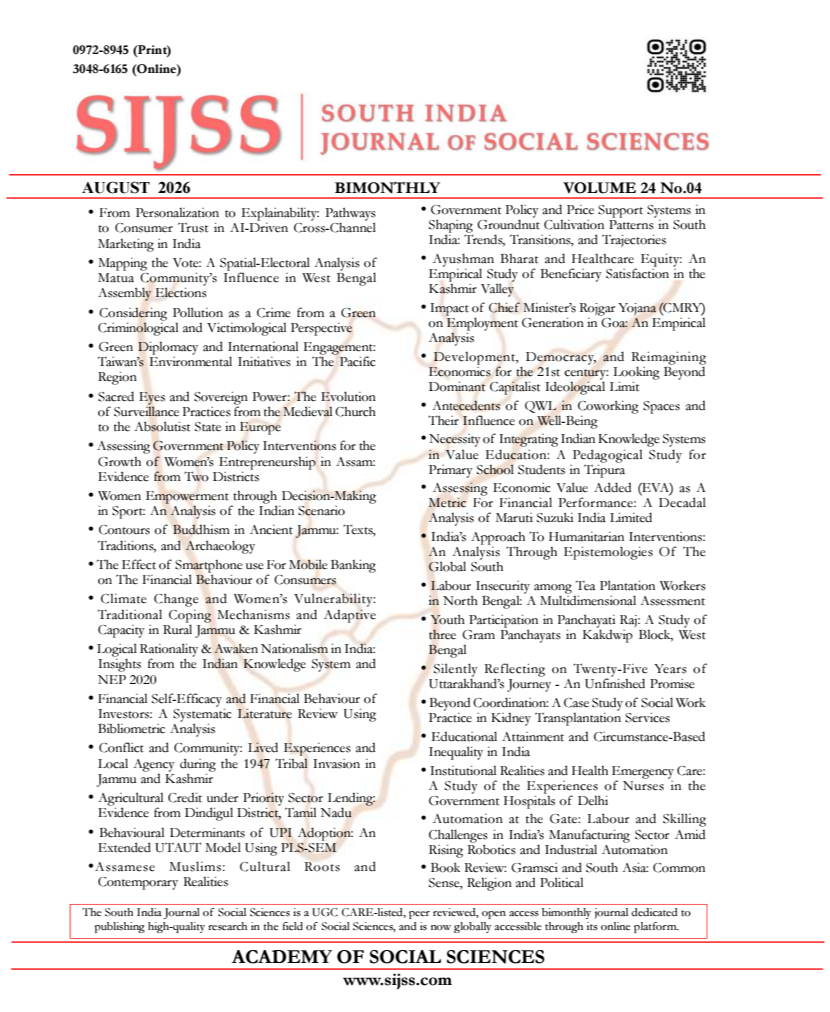
Development, democracy, and economics are inherently intertwined, so a deeper understanding and analysis of these three categories cannot be achieved without examining their relationship. The normative contents of development and democracy shall be examined through the lens of economic ideology, assuming that the financial discipline has a necessary connection with the ideology of development and democracy, which cannot be separated.
Assuming that development, democracy and economics have an ideological inclination, this paper examines how the ills of the capitalist mode of development and neo-liberal and neo-colonial ideologies are being advanced and executed in the name of development and democracy, which resulted in inequality, depletion of natural resurces, the concentration of wealth, climate change, the international division of labour and exploitation of natural resources.
Thus, this theoretical paper will examine development, democracy, and economics as an ideological project operating under a capitalist structural framework beyond economic determinism. It will also analyse the inherent contradictions of the dominant capitalist framework of development and democracy, and how it serves the interests of the dominant global north compared to the worldwide south structurally and technologically.
After analysing the capitalist mode of development operating through liberal, neoliberal and neocolonial apparatus, the paper will look at economic ideology connected with development and democracy instead of as an independent discipline in the material conditions of the 21st century. The recommendation for the new economics, keeping in mind the new material conditions of politics, power, and technological changes, will be made where the inequality, environmental degradation, exploitation of cheap labour and resources, the concentration of wealth, war and violation of rights of marginalised sections can be satisfactorily and effectively addressed.
References
1. Althusser, Louis (1971): Lenin and Philosophy and Other Essays, New York: Monthly Review Press.
2. Amin, Samir (1976): Unequal Development: An Essay on the Social Formations of Peripheral Capitalism, New York: Monthly Review Press.
3. Chomsky, Noam (2003): Hegemony or Survival: America’s Quest for Global Dominance, London: Penguin.
4. Chomsky, Noam (2016): Who Rules the World?, London: Penguin.
5. Escobar, Arturo (1995): Encountering Development: The Making and Unmaking of the Third World, Princeton: Princeton University Press.
6. Fraser, Nancy (2018): Capitalism: A Conversation in Critical Theory, Cambridge: Polity Press.
7. Fukuyama, Francis (1992): The End of History and the Last Man, London: Penguin.
8. Gettysburg Address (1863): Available at http://www.abrahamlincolnonline.org/lincoln/speeches/gettysburg.htm
9. Gramsci, Antonio (1971): Selections from the Prison Notebooks, edited and translated by Quintin Hoare and Geoffrey Nowell Smith, New York: International Publishers.
10. Harvey, David (2005): A Brief History of Neoliberalism, Oxford: Oxford University Press.
11. Hayek, Friedrich A (1944): The Road to Serfdom, London: Routledge.
12. Hayek, Friedrich A (1960): The Constitution of Liberty, Chicago: University of Chicago Press.
13. Huntington, Samuel P (1996): The Clash of Civilisations and the Remaking of World Order, New York: Simon & Schuster.
14. Lane, David (2023): Global Neoliberal Capitalism and the Alternatives: From Social Democracy to State Capitalism, Bristol: Policy Press.
15. Naoroji, Dadabhai (1901): Poverty and Un-British Rule in India, New Delhi: Commonwealth Publishers.
16. Nozick, Robert (1974): Anarchy, State, and Utopia, Oxford: Blackwell.
17. Peet, Richard and Elaine Hartwick (2015): Theories of Development: Contentions, Arguments, Alternatives, 3rd ed, New York: Guilford Press.
18. Piketty, Thomas (2014): Capital in the Twenty-First Century, Cambridge, MA: Harvard University Press.
19. Piketty, Thomas (2022): A Brief History of Equality, Cambridge, MA: Harvard University Press.
20. Polanyi, Karl (2001): The Great Transformation: The Political and Economic Origins of Our Time, 2nd ed, Boston: Beacon Press (first published 1944).
21. Rawls, John (1971): A Theory of Justice, Cambridge, MA: Harvard University Press.
22. Sachs, Jeffrey D (2005): The End of Poverty: Economic Possibilities for Our Time, New York: Penguin Press.
23. Sandel, Michael J (2009): Justice: What’s the Right Thing to Do?, New York: Farrar, Straus and Giroux.
24. Sen, Amartya (1999): Development as Freedom, Oxford: Oxford University Press.
25. Sen, Amartya (2009): The Idea of Justice, London: Penguin.
26. Stiglitz, Joseph E (2002): Globalisation and Its Discontents, New York: W. W. Norton.
27. Tharoor, Shashi (2016): An Era of Darkness: The British Empire in India, New Delhi: Rupa Publications.
28. Wallerstein, Immanuel (2004): World-Systems Analysis: An Introduction, Durham, NC: Duke University Press.
29. “Washington Consensus: Assessing a Damaged Brand” (2010): World Bank Policy Research Working Paper, available at https://documents1.worldbank.org/curated/en/848411468156560921/pdf/WPS5316.pdf
30. World Bank (2020): Poverty and Shared Prosperity 2020: Reversals of Fortune, Washington, DC: World Bank.
31. World Bank (2022): Poverty and Shared Prosperity 2022: Correcting Course, Washington, DC: World Bank.
32. World Inequality Lab (2022): World Inequality Report 2022, Paris: World Inequality Lab.

This work is licensed under a Creative Commons Attribution-NonCommercial-NoDerivatives 4.0 International License.
Copyright (c) 2026 South India Journal of Social Sciences