












Keywords
urban slum
development induced displacement
Dravidian Model
Ghettoization
World Bank
How to Cite




Abstract
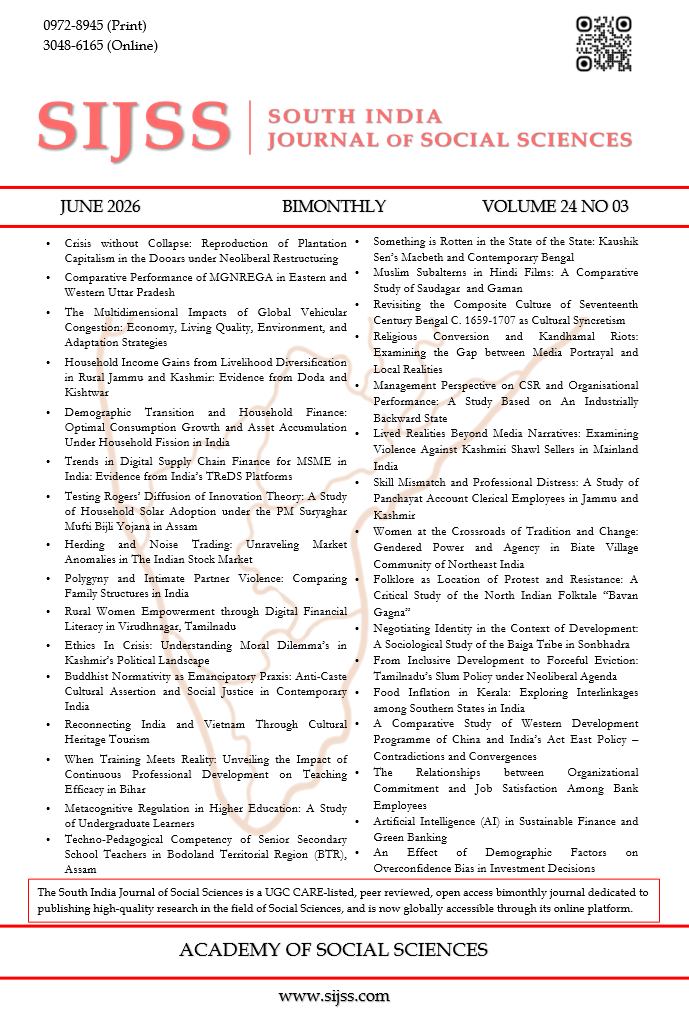
This paper problematizes the concepts of urbanization and urban resettlement, focusing on Chennai. The way urbanization and development are conceived underwent a paradigm shift after India adopted the 1991 economic reforms. The economic reforms shifted the state's role from service provider to facilitator, and this phenomenon is explored in this paper. This study seeks to interpret the negotiation between the state and the market and its larger impact on the state's policy. By drawing on these discussions, the paper seeks to unveil a perspective towards social justice aimed at inclusive policy frameworks in the future.
References
1. Davis, M. (2006). Planet of Slums. New York: Verso
2. Gooptu, N. (2001). The Politics of the Urban Poor in Early Twentieth Century India. Cambridge: Cambridge University Press
3. Guha, S.B. (2010). Accumulation by Dispossession - Transformative Cities in the New Global Order. New Delhi: Sage Publications
4. Harvey, D. (1973). Social Justice and the City. Johns Hopkins University Press
5. Harvey, D. (2003). The New Imperialism. New York: Oxford University Press
6. Harvey, D. (2005). A Brief History of Neoliberal-ism. New York: Oxford University Press
7. Harvey, D. (2008). The Right to the City. New Left Review 53 (Sep - Oct 2008), pp. 23-40
8. Harvey, D. (2004). The New Imperialism: Accumulation by Dispossession. Socialist Register, 2004. pp. 63-87
9. Pugh, C. (1990). Housing and Urbanisation - A Study of India. New Delhi: Sage Publications
10. Raman, N. (2011). The Board and the Bank: Chang-ing Policies towards Slums in Chennai. Economic and Political Weekly, VOL XLVI NO 31. pp. 74-80
11. Wiebe, P. (1981). Tenants and Trustees (Calcutta: Macmillan India).

This work is licensed under a Creative Commons Attribution-NonCommercial-NoDerivatives 4.0 International License.
Copyright (c) 2026 South India Journal of Social Sciences