





Keywords
Plagiarism
QAA
Similarity
Software
TEQSA
UGC regulations
Categories
How to Cite


Abstract
The University Grants Commission (Promotion of Academic Integrity and Prevention of Plagiarism in Higher educational institutions) Regulations was notified in 2018 with the intended goal of promoting academic integrity and preventing plagiarism across higher educational institutions in India. As a decade approaches since its enforcement, the study critically analyses the provisions of the regulations in achieving its objectives. The regulations mostly concentrate on putting in place measures to prevent plagiarism rather than addressing the problem of academic misconduct in a comprehensive manner. It advocates for the use of software that generates a similarity index or score to determine the occurrence of plagiarism, disregarding the various limitations associated with such technologies. The regulations are silent on the application of human judgment despite it being crucial to identifying instances of plagiarism. Moreover, the regulations take a punitive approach by recommending various penalties for different levels of similarity. Drawing on the approaches of quality agencies in other countries, namely the Tertiary Education Quality and Standards Agency (TEQSA) of Australia and the UK's Quality Assurance Agency for Higher Education (QAA), the study highlights that increasingly the preferred approach to address plagiarism and other misconduct is through the promotion of academic integrity among students. It concludes that deterring academic misconduct requires mature and comprehensive strategies. Students, faculty, and institutions must work together to promote a culture of academic integrity.
References
1. Awasthi, S., & Tripathi, M. (2021). Challenges in using anti-plagiarism software: A case study. Annals of Library and Information Studies, 68(3), 289–293.
2. Bretag, T., & Mahmud, S. (2009). A model for determining student plagiarism: Electronic detection and academic judgement. Journal of University Teaching and Learning Practice, 6(1), 50–60. https://doi.org/10.53761/1.6.1.6
3. Department of Education, Skills and Employment, Canberra. (2021). Higher Education Standards Framework (Threshold Standards) 2021. Federal Register of Legislation. https://www.legislation.gov.au/F2021L00488/latest/text
4. Gniel, H., Treloar, K., Marcon, R., & Maclean, A. (2024). Challenges and Solutions: A National Perspective from Australia. In Second Handbook of Academic Integrity (pp. 1905–1920). https://doi.org/10.1007/978-3-031-54144-5
5. Hendricks, M., & Quinn, L. (2000). Teaching Referencing as an Introduction to Epistemological Empowerment. Teaching in Higher Education, 5(4), 447–457. https://doi.org/10.1080/713699175
6. Mansoor, F., Ameen, K., & Arshad, A. (2024). An exploratory study of university librarians’ perceptions on causes and deterrents of plagiarism: A Pakistani perspective. Global Knowledge, Memory and Communication, 73(4/5), 634–649. https://doi.org/10.1108/GKMC-04-2022-0074
7. McCabe, D. L. (2005). Cheating among college and university students: A North American perspective. International Journal for Educational Integrity, 1(1). https://doi.org/10.21913/IJEI.v1i1.14
8. Meo, S. A., & Talha, M. (2019). Turnitin: Is it a text matching or plagiarism detection tool? Saudi Journal of Anaesthesia, 13, 48–51. https://doi.org/10.4103/sja.SJA_772_18
9. Myer, L., & Smith, A. W. (2024). Academic Integrity in the United Kingdom: The Quality Assurance Agency’s National Approach. In Second Handbook of Academic Integrity (pp. 841–858). https://doi.org/10.1007/978-3-031-54144-5
10. Pandita, R., & Singh, S. (2019). Regulations to Prevent Plagiarism in Higher Education in India: A Critical Appraisal. DESIDOC Journal of Library & Information Technology, 39(2), 67–73. https://doi.org/10.14429/djlit.39.2.14115
11. QAA. (2020). Academic Integrity Charter for UK Higher Education. https://www.qaa.ac.uk/docs/qaa/about-us/academic-integrity-charter.pdf?sfvrsn=93f0d181_8
12. QAA. (2024). UK Quality Code for Higher Education. https://www.qaa.ac.uk/docs/qaa/quality-code/uk-quality-code-for-higher-education-2024.pdf?sfvrsn=19a5b881_32
13. Satija, M. P., & Martínez-Ávila, D. (2019). Plagiarism: An Essay in Terminology. DESIDOC Journal of Library & Information Technology, 39(2), 87–93. https://doi.org/10.14429/djlit.39.2.13937
14. Sivasubramaniam, S. D. (2024). Academic Integrity in South Asia: Focus on India, Pakistan, and Sri Lanka. In Second Handbook of Academic Integrity (pp. 77–93). https://doi.org/10.1007/978-3-031-54144-5
15. Taylor, J. S. (2024). Reassessing Academic Plagiarism. Journal of Academic Ethics, 22, 211–230. https://doi.org/10.1007/s10805-023-09478-4
16. TEQSA. (2015). Report on student academic integrity and allegations of contract cheating by university students. https://www.teqsa.gov.au/sites/default/files/report-on-student-academic-integrity-allegations-contract-cheating.pdf
17. TEQSA. (2024). Guidance note: Academic and research integrity. https://www.teqsa.gov.au/sites/default/files/2024-02/guidance-note-academic-and-research-integrity_0.pdf
18. TEQSA. (2026). What is academic integrity? https://www.teqsa.gov.au/students/understanding-academic-integrity/what-academic-integrity
19. UGC. (2018). University Grants Commission (Promotion of Academic Integrity and Prevention of Plagiarism in Higher Educational Institutions) Regulations, 2018. https://www.ugc.gov.in/pdfnews/7771545_academic-integrity-Regulation2018.pdf
20. UGC. (2020). Self-Plagiarism. https://www.ugc.gov.in/pdfnews/2284767_self-plagiarism001.pdf
21. Warn, J. (2006). Plagiarism software: No magic bullet! Higher Education Research & Development, 25(2), 195–208. https://doi.org/10.1080/07294360600610438
22. Youmans, R. J. (2011). Does the adoption of plagiarism-detection software in higher education reduce plagiarism? Studies in Higher Education, 36(7), 749–761. https://doi.org/10.1080/03075079.2010.523457

This work is licensed under a Creative Commons Attribution-NonCommercial-NoDerivatives 4.0 International License.
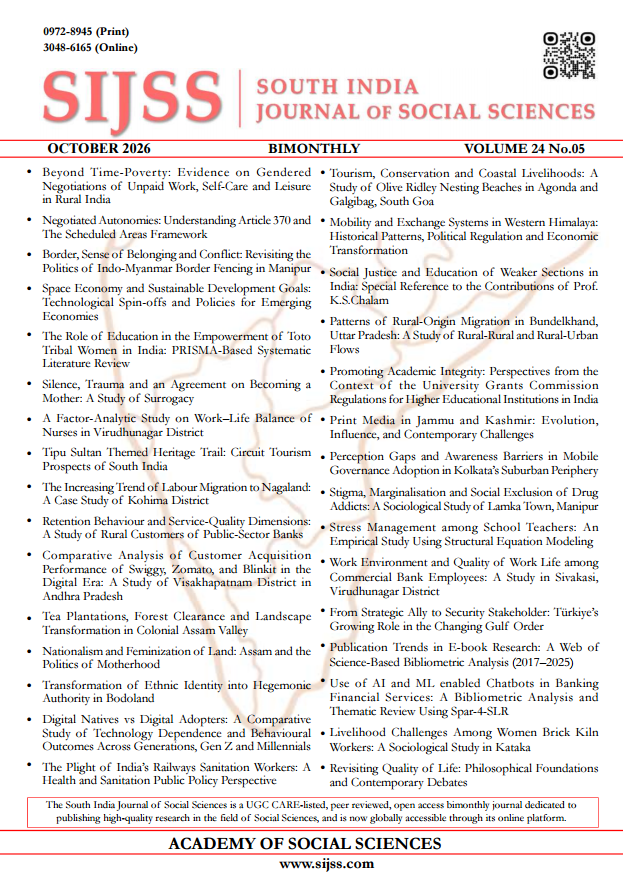
Copyright (c) 2026 South India Journal of Social Sciences