












Keywords
Profitability Ratio
Debt Coverage Ratio
Sustainable Operation Practice
How to Cite




Abstract
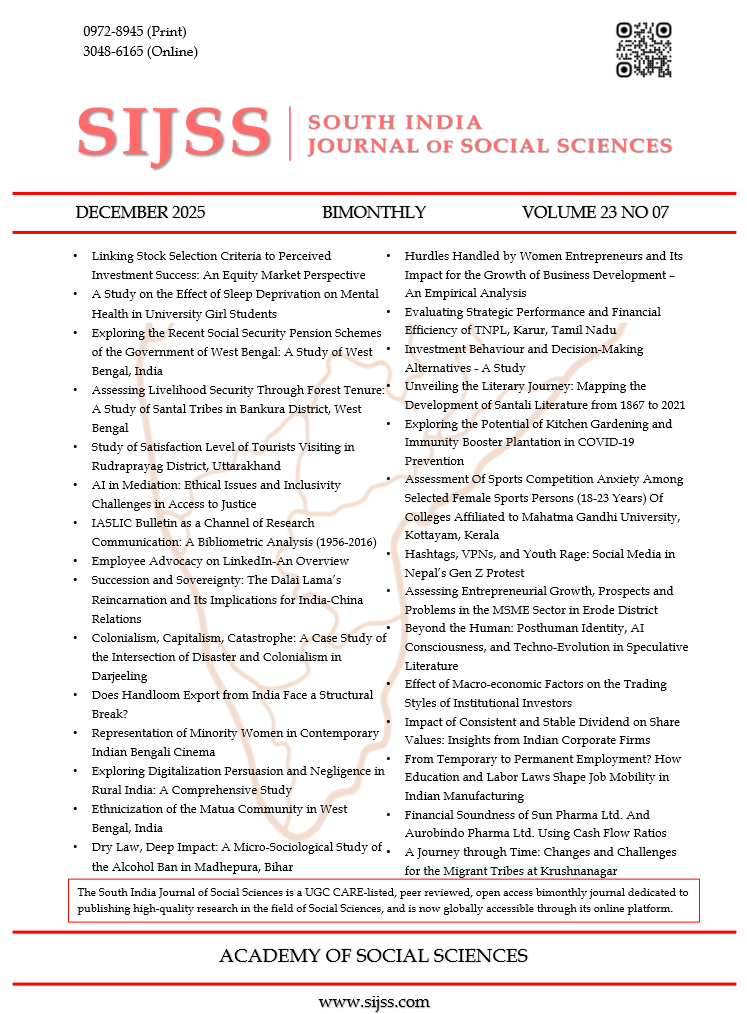
The present article gives a detailed analysis of the financial performance of one of the prominent publicly-run companies in the Indian paper mill industry, Tamil Nadu Newsprint and Papers Limited (TNPL). The analysis of financial efficiency, profitability, liquidity, and solvency of the company is reviewed in relation to the financial period of five years, 2018 to 2022, based on the secondary data, according to the official annual reports and the official financial portals. The performance trend has been analyzed using the ratio analysis to find out the financial stability of the firm. The findings reveal that the profitability and the amount of the working capital change significantly and, in general, are contingent on the instability of the market environment, the increase in expenses, and the changes in the economy following the pandemic. Despite these strains, TNPL is financially strong because of its strength in asset efficiencies and good utilization of debt. The paper highlights the strategic importance of enhancing liquidity, cost structural alignment and the adoption of sustainable operation practices. Moreover, the financial management of TNPL is placed in the wider framework of the Indian industrial competitiveness and environmental responsibility that underlines the fact that long-term development of the company will be based on the logistics of profitability and the sustainability of value creation and strategic reinvestment in eco-efficient technologies
References
1. Altman, E. I. (1968). Financial ratios, discriminant analysis and the prediction of corporate bankrupt-cy. Journal of Finance, 23(4), 589–609. https://doi.org/10.1111/j.1540-6261.1968.tb00843.x
2. Bansal, D. (2010). Impact of liberalisation on productivity and profitability of public sector banks in India (Doctoral dissertation, Saurashtra University).
3. Bieliaieva, N., Krushelnytskyi, M., Voliak, L., Usa-ta, N., & Sova, O. (2020). From survival to busi-ness prosperity: The financial aspect of managing an organization in a crisis. Independent Journal of Management & Production, 11(9), 2275–2290.DOI:10.14807/ijmp.v11i9.1414
4. Campbell, J. Y., Hilscher, J., & Szilagyi, J. (2008). In search of distress risk. The Journal of Finance, 63(6), 2899–2939. https://doi.org/10.1111/j.1540-6261.2008.01416.x.
5. Mullins, D. (2020). Are your cash-flow tools re-cession-ready? Harvard Business Review / Finan-cial Management Review (practitioner piece). (See PubMed entry.) https://pubmed.ncbi.nlm.nih.gov/32327763/
6. Rahman, M. M., Jahan, N., & Mahmud, S. (2009). Determinants of bank profitability: Evidence from Bangladesh. Journal of Business and Technology (Dhaka), 4(3), 45–56. https://doi.org/10.5539/ijbm.v10n8p135
7. Kishore, R. M. (2019). Taxmann’s workbook on cost accounting and financial management. Tax-mann Allied Services Pvt. Ltd.
8. Money control. (2022). Tamil Nadu Newsprint and Papers Ltd financial statements 2018–2022. Re-trieved from https://www.moneycontrol.com
9. Tamil Nadu Newsprint and Papers Limited. (2022). Annual reports 2018–2022. Retrieved from https://www.tnpl.com
10. Goddard, J., Molyneux, P., & Wilson, J. O. S. (2004). The profitability of European banks: A cross-sectional and dynamic panel analysis. Jour-nal of International Financial Markets, Institu-tions & Money, 14(3), 175–191. https://doi.org/10.1111/j.1467-9957.2004.00397.x
11. Bourke, P. (1989). Concentration and other deter-minants of bank profitability in Europe, North America and Australia. Journal of Banking & Fi-nance, 13(1), 65–79. https://doi.org/10.1016/0378-4266(89)90020-4.
12. Athanasoglou, P. P., Brissimis, S. N., & Delis, M. D. (2008). Bank-specific, industry-specific and mac-roeconomic determinants of bank profitability. Journal of International Financial Markets, Insti-tutions & Money, 18(2), 121–136. https://doi.org/10.1016/j.intfin.2006.07.002.
13. Demirgüç-Kunt, A., & Huizinga, H. (1999). Deter-minants of commercial bank interest margins and profitability: Some international evidence. World Bank Economic Review, 13(2), 379–408. https://doi.org/10.1093/wber/13.2.379

This work is licensed under a Creative Commons Attribution-NonCommercial-NoDerivatives 4.0 International License.
Copyright (c) 2025 South India Journal of Social Sciences