













Keywords
Demographic Factor
AI Perceiption
Education
India
Technology Acceptance
How to Cite




Abstract
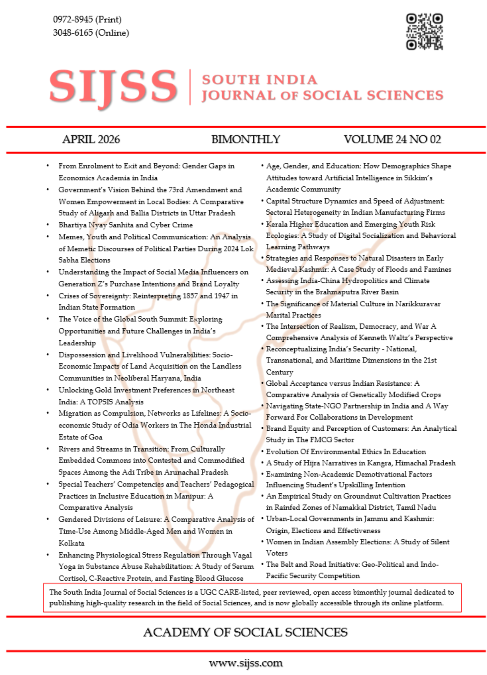
This study examines how academics and learners in Sikkim, India's higher education institutions view the impact of artificial intelligence (AI) in connection to demographic variables. In order to promote inclusive adoption of AI as technology becomes more and more incorporated into education, it is essential to comprehend how socioeconomic position, age, gender, educational background, and vocation affect views toward AI Structured questionnaires were used to gather data from 100 teachers and 100 University and college students using convenience sampling as part of a mixed-methods strategy. The chi-square tests are used to assess the association between demographic profiles and AI perceptions. The Key findings imply clear demographic imbalance: older versus younger and less versus more educated people report different perceived AI, Gender distinctness was also evident. The research emphasizes the importance of both targeted AI literacy education programs and policy measures to deal with population-specific issues, providing young people with equally fair accesses to AI integrated education. This understanding adds to the worldwide discussion on AI acceptance and provides country-specific advice to educators and policy-makers in India.
References
1. Catalina, Q. M., Femenia, J., Fuster-Casanovas, A., Marín-Gomez, F. X., Escalé-Besa, A., Solé‐Casals, J., & Vidal-Alaball, J. (2023).Knowledge and Perception of the Use of AI and its Implementation in the Field of Radiology: Cross-Sectional Study (Preprint). https://doi.org/10.2196/preprints.50728
2. Beets, B., Newman, T. P., Howell, E. L., Bao, L., & Yang, S. (2023). Surveying Public Perceptions of Artificial Intelligence in Health Care in the United States: Systematic Review. Journal of Medical Internet Research. https://doi.org/10.2196/40337
3. Bozkurt, V., & Gürsoy, D. (2023). The Artificial Intelligence Paradox: Opportunity or Threat for Humanity?International Journal of Human-Computer Interaction. https://doi.org/10.1080/10447318.2023.2297114
4. Kim, T., Molina, M. D., Rheu, M., & Peng, W. (2023). One AI Does Not Fit All: A Cluster Analysis of the Laypeople’s Perception of AI Roles.International Conference on Human Factors in Computing Systems. https://doi.org/10.1145/3544548.3581340
5. Moravec, V., Hynek, N., Gavurová, B., & Kubák, M. (2024). Everyday artificial intelligence unveiled: Societal awareness of technological transformation.Oeconomia Copernicana. https://doi.org/10.24136/oc.2961
6. Brauner, P., Glawe, F., Liehner, G. L., Vervier, L., & Ziefle, M. (2024).Mapping Public Perception of Artificial Intelligence: Expectations, Risk-Benefit Tradeoffs, and Value As Determinants for Societal Acceptance. https://doi.org/10.48550/arxiv.2411.19356
7. Novozhilova, E., Mays, K. K., Paik, S., & Katz, J. E. (n.d.). More Capable, Less Benevolent: Trust Perceptions of AI Systems across Societal Contexts.Machine Learning and Knowledge Extraction. https://doi.org/10.3390/make6010017
8. Gerlich, M. (2023). Perceptions and Acceptance of Artificial Intelligence: A Multi-Dimensional Study.The Social Science. https://doi.org/10.3390/socsci12090502
9. Budeanu, A.-M., Turcanu, D. S., & Rosner, D. (2023).European Perceptions of Artificial Intelligence and Their Social Variability. An Exploratory Study. https://doi.org/10.1109/cscs59211.2023.00075
10. Ding, L., Tong, L., & Turkson, A. (2024).(Mis)conceptions and perceptions of artificial intelligence: A scoping review. https://doi.org/10.35542/osf.io/y627r
11. Seth, J. (2024). Public Perception of AI: Sentiment and Opportunity.arXiv.Org. https://doi.org/10.48550/arxiv.2407.15998
12. Kelley, P. G., Yang, Y., Heldreth, C., Moessner, C., Sedley, A., Kramm, A., Newman, D. T., & Woodruff, A. (2021). Exciting, Useful, Worrying, Futuristic: Public Perception of Artificial Intelligence in 8 Countries.National Conference on Artificial Intelligence. https://doi.org/10.1145/3461702.3462605
13. Brauner, P., Hick, A., Philipsen, R., & Ziefle, M. (2023).What does the public think about artificial intelligence?—A criticality map to understand bias in the public perception of AI. https://doi.org/10.3389/fcomp.2023.1113903
14. Celik, B. H. (2024). Analyzing Public Perception of AI: A Descriptive Study of AI Coverage in US Newspapers.Yeni Medya. https://doi.org/10.55609/yenimedya.1532473
15. Yigitcanlar, T., Degirmenci, K., & Inkinen, T. (2022). Drivers behind the public perception of artificial intelligence: insights from major Australian cities.Ai & Society. https://doi.org/10.1007/s00146-022-01566-0
16. Liehner, G. L., Hick, A., Biermann, H., Brauner, P., & Ziefle, M. (2023). Perceptions, attitudes and trust toward artificial intelligence — An assessment of the public opinion.AHFE International. https://doi.org/10.54941/ahfe1003271
17. Flores, C. (2024).Building Trust in the AI Ecosystem by Re-Evaluating Public Perception. https://doi.org/10.5070/cr37224
18. Kim, S. (2024).Perceptions of Discriminatory Decisions of Artificial Intelligence: Unpacking the Role of Individual Characteristics. https://doi.org/10.48550/arxiv.2410.13250
19. Kaya, F., Aydin, F., Schepman, A., Rodway, P., Yetişensoy, O., & Kaya, M. D. (2022). The Roles of Personality Traits, AI Anxiety, and Demographic Factors in Attitudes toward Artificial Intelligence.International Journal of Human-Computer Interaction. https://doi.org/10.1080/10447318.2022.2151730
20. Grassini, S., & Ree, A. S. (2023).Hope or Doom AI-ttitude? Examining the Impact of Gender, Age, and Cultural Differences on the Envisioned Future Impact of Artificial Intelligence on Humankind. https://doi.org/10.1145/3605655.3605669
21. Gnambs, T., Stein, J., Zinn, S., Griese, F., & Appel, M. (2025).Attitudes, Experiences, and Usage Intentions of Artificial Intelligence: A Population Study in Germany. https://doi.org/10.31234/osf.io/6u49f
22. Alkadi, R. S. (2025). Demographic variations in intentions towards artificial intelligence-driven financial services in emerging economies: A study of Saudi Arabia.The Business & Management Review. https://doi.org/10.24052/bmr/v15nu03/art-02
23. Tin, T. T. (2024). Demographic Factors Shaping Artificial Intelligence (AI) Perspectives: Exploring Their Impact on University Students’ academic performance.Pakistan Journal of Life and Social Sciences. https://doi.org/10.57239/pjlss-2024-22.2.000876
24. Bartneck, C., Yogeeswaran, K., & Sibley, C. G. (2023). Personality and demographic correlates of support for regulating artificial intelligence.AI and Ethics. https://doi.org/10.1007/s43681-023-00279-4

This work is licensed under a Creative Commons Attribution-NonCommercial-NoDerivatives 4.0 International License.
Copyright (c) 2026 South India Journal of Social Sciences