













Keywords
Northeast India
Regional Connectivity
Western Development Programme
Yunnan Province
How to Cite




Abstract
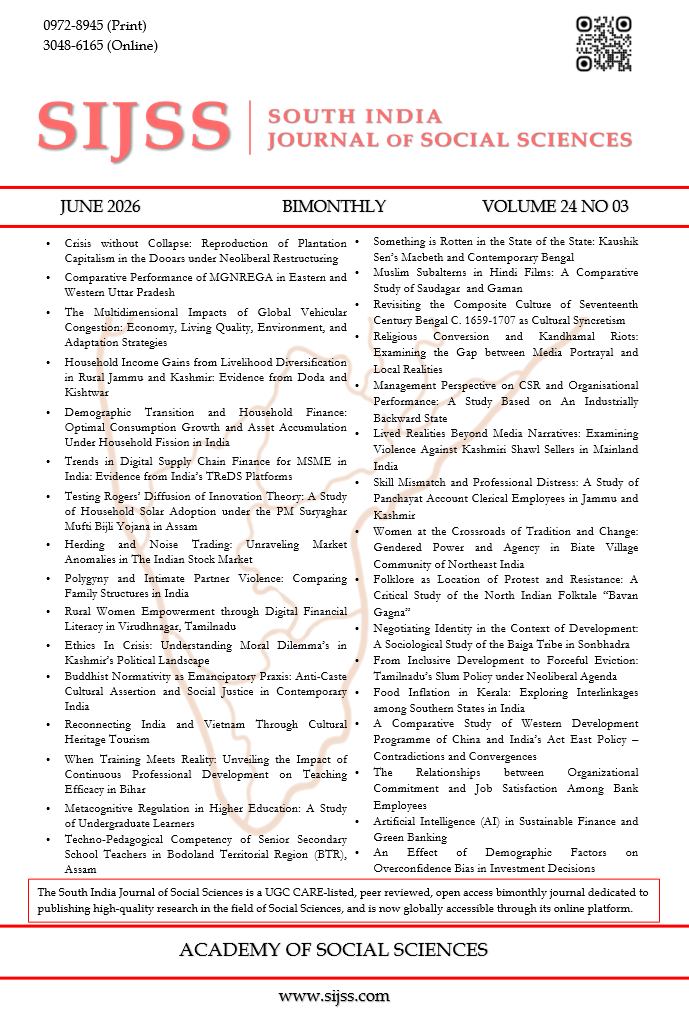
This paper compares the Western Development Programme (WDP) of China in Yunnan Province and the Act East Policy (AEP) of India. These two initiatives are formulated to integrate borderland regions with Southeast Asia. Accordingly, the centre-periphery theory, border studies scholarship, and securitisation form the analytical framework. The study explains that Yunnan’s transformation under the WDP is an example of sustained infrastructure investment, policy continuity, and cross-border economic integration. In concurrence, WDP has helped bring about transformation in the historically marginalised and ethnically diverse Yunnan province. On the contrary, India’s AEP is beset with implementation loopholes. The AEP has made comparatively less progress than WDP due to a lack of infrastructure and security concerns, compounded by bureaucratic inefficiencies in northeast India. Thus, northeast India attracts less investment. The paper concludes by proposing lessons for India in the light of WDP. As a result, the paper contributes to understanding borderland development strategies and regional integration processes in India and China.
References
1. Asian Development Bank. (2011). People’s Republic of China: Western Yunnan Roads Development Project. Evaluation Document.
2. Bhattacharyay, B., & De, P. (2005). Promotion of trade and Investments between China and India : the case of Southwest China and East and Northeast India. CESifo Working Paper, (1508), 1–41.
3. Buzan, B., Wæver, O., & Wilde, J. d. (1998). Security: a new framework for analysis. Lynne Rienner Pub.
4. Consulate General of India. (n.d.). Yunnan. Consulate General of India, Guangzhou. Retrieved March 15, 2026, from https://www.cgiguangzhou.gov.in/page/yunnan/
5. Das, S. B., & Chattopadhyay, S. (2022). Identifying Challenges and Improving Trade Facilitation in the States of Northeast India. ADB South Asia Working Paper Series, 95, 1–38.
6. Diener, A. C., & Hagen, J. (2012). Borders: A Very Short Introduction. Oxford University Press.
7. Embassy of India, Yangon. (2022). Bilateral economic & commercial brief.
8. Fruman, C. (2023, March 1). In Northeast India, All Roads Lead to Greater Development. Work Bank Blog. Retrieved February 7, 2026, from https://blogs.worldbank.org/en/endpovertyinsouthasia/northeast-india-all-roads-lead-greater-development
9. Hechter, M. (1975). Internal Colonialism: The Celtic Fringe in British National Development, 1536-1966. University of California Press.
10. Hong Kong Trade Development Council. (2022, September 26). Yunnan: Market Profile. HKTDC Research. Retrieved March 15, 2026, from https://research.hktdc.com/en/data-and-profiles/mcpc/provinces/yunnan
11. Kurian, N. (2014). India-China Borderlands: Conversations Beyond the Centre. SAGE Publications.
12. Lai, H. H. (2002). China’s Western Development Program: Its Rationale, Implementation, and Prospects. Modern China, 28(4), 432-466. https://doi.org/10.1177/009770040202800402
13. Lu, Z., & Deng, X. (2013). Regional policy and regional development: A case study of China’s Western Development Strategy. Annales Universitatis Apulensis Series Oeconomica, 15(1).
14. Ministry of External Affairs. (2024). Ministry of External Affairs Annual Report 2024. Ministry of External Affairs, Government of India.
15. Press Information Bureau. (2022, November 13). A New Era of Peace and Prosperity in the North East. Government of India Press Information Bureau. https://www.pib.gov.in/FeaturesDeatils.aspx?NoteId=151186&ModuleId=2®=3&lang=1
16. Rajendram, D. (2014). India’s new Asia-Pacific strategy: Modi acts East. Lowy Institute for International Policy, 1-22.
17. Rana, K. S., & Oberoi, P. (2012, December). India’s North East States: The BCIM Forum and Regional Integration. ICS Monograph, (1), 1-152.
18. Research and Information System for Developing Countries. (2011). Expansion of North East India’s trade and investment with Bangladesh and Myanmar: An assessment of the opportunities and constraints. Ministry of Development of North Eastern Region, & North Eastern Council.
19. Shih, V. (2004). Development, the Second Time Around: The Political Logic of Developing Western China. Journal of East Asian Studies, 4(3), 427-451.
20. Song, Tao, Chahine, T., & Sun, M. (2020). Ruili, China: The China–Myanmar nexus hub at the crossroads. Cities, 104(102766), 1-10.
21. https://doi.org/10.1016/j.cities.2020.102766
22. The State Council of the People’s Republic of China. (2024a, February 22). Yunnan’s trade with South and Southeast Asia soars 42% in 9 years. The State Council of the People's Republic of China. Retrieved March 15, 2026, from https://english.www.gov.cn/news/202402/22/content_WS65d6f0bcc6d0868f4e8e440a.html
23. The State Council of the People’s Republic of China. (2024b, December 4). China-Laos Railway boosts growth of regional trade, tourism. The State Council of the People's Republic of China. Retrieved February 10, 2026, from https://english.www.gov.cn/news/202412/04/content_WS674fa5a9c6d0868f4e8eda75.html
24. Strangio, S. (2025, February 21). Vietnam’s National Assembly Approves $8B Rail Link to China. The Diplomat. Retrieved January 25, 2026, from https://thediplomat.com/2025/02/vietnams-national-assembly-approves-8b-rail-link-to-china/?utm_source=newsletter&utm_medium=email&utm_campaign=diplomat_brief&utm_id=diplomat_brief-2025-no08-feb-26&v=1
25. Wallerstein, I. (2011). The Modern World-System I: Capitalist Agriculture and the Origins of the European World-Economy in the Sixteenth Century. University of California Press.
26. Wong, D. (2020, March 30). Yunnan Investment Profile: Industry, Economics, and Support Policies for Businesses. China Briefing. Retrieved March 15, 2026, from https://www.china-briefing.com/news/yunnan-investment-profile-industry-economics-and-support-policies-for-business/
27. Yang, L., & Wall, G. (2009). Minorities and tourism: community perspectives from Yunnan, China. Journal of Tourism and Cultural Change, 7(2), 77–98. https://doi.org/10.1080/14766820902849971

This work is licensed under a Creative Commons Attribution-NonCommercial-NoDerivatives 4.0 International License.
Copyright (c) 2026 South India Journal of Social Sciences