












Keywords
Tea Plantation Workers
North Bengal
Dooars
Darjeeling
Labour Vulnerability
Categories
How to Cite




Abstract
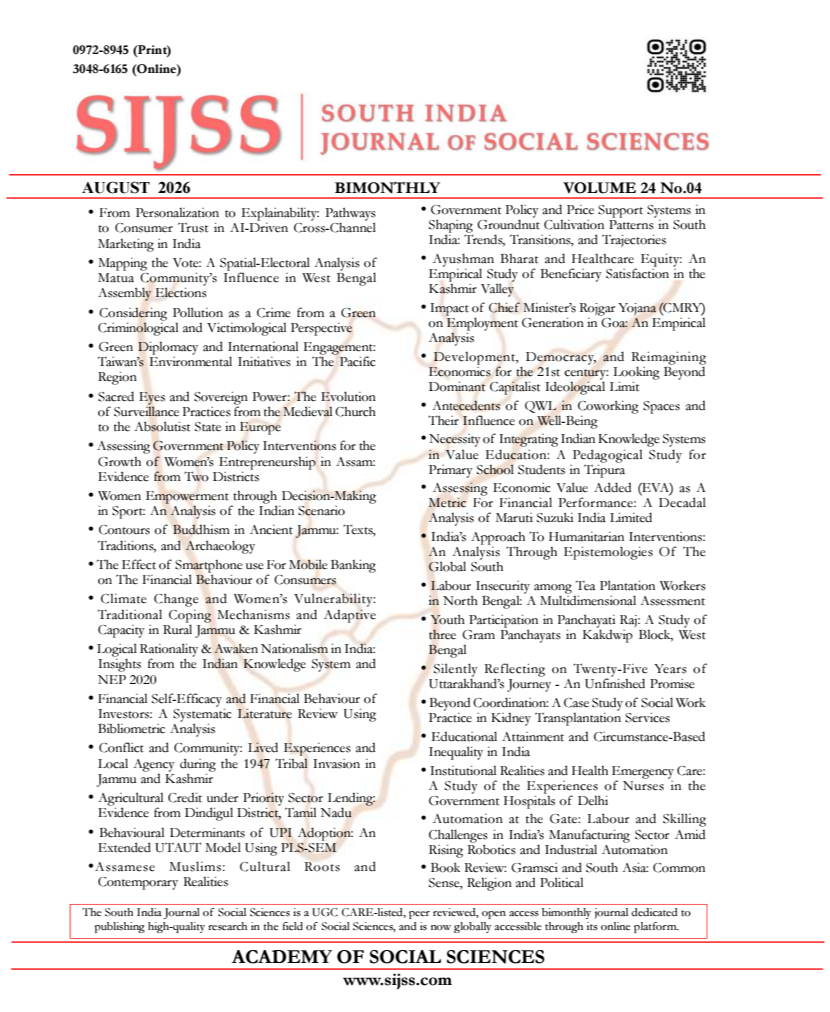
Tea plantations have long remained the principal source of livelihood for workers in North Bengal, yet concerns regarding labour vulnerability continue to persist across plantation communities. Drawing on the ILO's multidimensional labour security framework, this study examines the nature and regional variation of labour security among tea plantation workers in the Dooars and Darjeeling regions of North Bengal. The analysis is based on primary data collected from workers' households and assesses labour security across seven dimensions: Economic Security, Employment Security, Income Security, Workplace Security, Health Security, Social Security and Representation Security. Dimension-specific security scores were constructed using normalized indicators and analyzed through descriptive statistics and independent t-tests.
The finding reveals a highly uneven labour security profile among workers of the North Bengal tea plantation region, while Economic Security, Income Security and Employment Security emerged as the most vulnerable dimensions. Significant regional differences were observed in Employment Security, Workplace Security, Health Security and Representation Security , whereas Economic Security, Income Security and Social security showed no statistically significant variation. Importantly, relatively favourable outcomes in certain dimensions were found to coexist with persistent livelihood vulnerabilities. The study argues that estate-based welfare provisions and employment continuity often mask deeper insecurities associated with low wages, poor working conditions, and limited livelihood opportunities. These findings underscore the need for a multidimensional approach to labour welfare and livelihood security in plantation economies.
References
1. Anker J. (2002), People’s Security Surveys: an outline of methodology and concepts. International Labour Office, Geneva, International labour review, Vol. 141 (4), pp. 309-329. 1564-913X; 0020-7780
2. Barman, Keshab, Migration Dynamics in North Bengal's Tea Gardens and a Comparative Perspective from Kerala (May 04, 2025). http://dx.doi.org/10.2139/ssrn.5561599
3. Besky, S. (2014). The Darjeeling Distinction: Labor and Justice on Fair-Trade Tea Plantations in India (Vol. 47). Univ. of California Press. 264 pp. ISBN:9780520277397
4. Bhowmik, S.K. (2015). Living conditions of tea plantation workers. 50. 29-32.
5. Breman, J. (1996). Footloose Labour: Working in India’s Informal Economy. Cambridge: Cambridge University Press
6. Golay, Dixchen & Hannan, Abdul. (2024). Labour Market and Livelihood Practices in the Closed Tea Gardens of Darjeeling Hills, West Bengal. International Journal of Rural Management. 21. 10.1177/09730052241261492.
7. Guha, Amalendu. (1977). Planter Raj to Swaraj: Freedom Struggle and Electoral Politics in Assam, 1826–1947. New Delhi: Indian Council of Historical Research
8. Gurung, Mamta & Mukherjee, Sanchari. (2018). Gender, Women and Work in the Tea Plantation: A Case Study of Darjeeling Hills. Indian Journal of Labour Economics. 61. 10.1007/s41027-018-0142-3.
9. International Labour Organization. (1999). “Report of the Director-General: Decent Work," Geneva: ILO. Available at: www2.ilo.org/public/english/standards/relm/ilc/ilc87/rep-i.htm, accessed in March 2019
10. Kakati, B. K. (2026). Livelihood challenges in closed tea estates: A case study of Jalpaiguri district of West Bengal, India. Local Development & Society, 7(1), 3–23. https://doi.org/10.1080/26883597.2025.2499451
11. Kantor, P., Rani, U., & Unni, J. (2006). Decent work deficits in informal economy: case of Surat. Economic and Political Weekly, 2089-2097.
12. Kirti, Kishlay. (2025). Social Security Benefits to Plan-tation Workers: A Case Study of Tea Gardens in West Bengal
13. Mishra, D. K., Sarma, A., & Upadhyay, V. (2011). Invisible chains? Crisis in the tea industry and the ‘unfreedom’ of labour in Assam’s tea plantations. Contemporary South Asia, 19(1), 75–90. https://doi.org/10.1080/09584935.2010.549557
14. Saha, D., Bhue, C., & Singha, R. (2019).Decent Work for Tea Plantation workers in Assam: Constraints, challenges and prospects. Tata Institute of Social Science, GuwahatiCampu-https://tiss.ac.in/uploads/files/TISS_Study_2019_Dcent_Work_for_Tea_Plantation_Workers_in_Assam_Web.pdf
15. Standing, G. (2002). From People's Security Surveys to a Decent Work Index. International Labour Review, 141(4), 441–454

This work is licensed under a Creative Commons Attribution-NonCommercial-NoDerivatives 4.0 International License.
Copyright (c) 2026 South India Journal of Social Sciences