













Keywords
Ethnicization
Hindu Nationalism
Matua
Ethnic Identity
Categories
- Anthropology, Sociology, Social Work, History & Archeology
- Geography, Environmental Studies, Sustainable Development & Area Studies
- Political Science, Public Policy, Law & International Relations
- Language Studies, Cultural Studies, Media and Communication & Library Science
- Education, Health, Psychology, Philosophy, Social Exclusion & Gender Studies
- Other Interdisciplinary Studies
How to Cite




Abstract
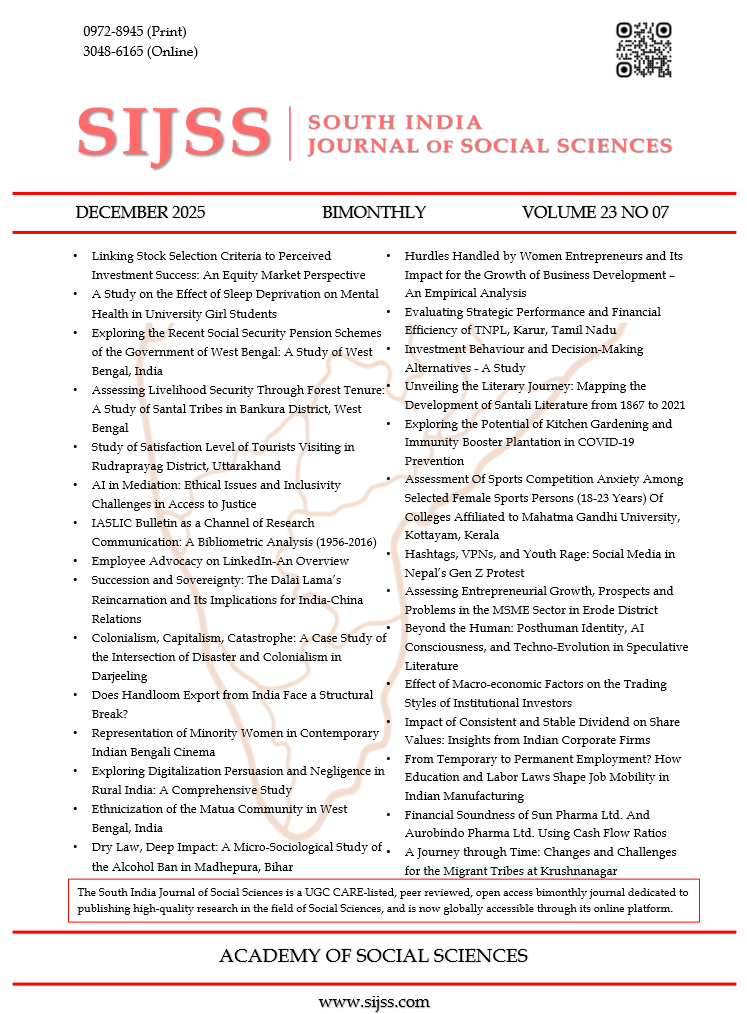
This paper examines the ethnicization of the Matua Community in West Bengal, India through a historical lens focusing on people who influenced the formation of their identity and socio-political consolidation. It first traces Harichand Thakur's religious movement around Kirtan, then the research goes on to present Guruchand Thakur's educational reforms as a turning point to social liberation. Next, the paper looks at the works of Pramatha Ranjan Thakur and Binapani Devi in bringing the low-caste Matua refugees together under a common socio-religious and political fold. Through a literature survey and discourse analysis, this research is a critical account of the changing Matua identity and the resulting caste dynamics and political mobilization in Bengal.
References
1. Bandyopadhyay, S. (2001). Matua Samaj o Pramatha Ranjan Thakur [Bengali]. Boipotro.
2. Bandyopadhyay, S., & Chaudhury, A. B. R. (2017). Partition in Bengal: Re-visiting the caste Question, 1946–47. Studies in History, 33(2), 234–261. https://doi.org/10.1177/0257643017717897
3. Banerjee-Dube, I. (2008). Caste in History. Oxford University press eBooks.
4. Biswas, M. (2018). Caste and Socio-cultural mobility in West Bengal: A hybrid cultural elocution of Matua Reforms Movement. Contemporary Voice of Dalit, 10(2), 232–243. https://doi.org/10.1177/2455328x18787568
5. Chandra, U., Heierstad, G., & Nielsen, K. B. (2015). The politics of caste in West Bengal. Routledge.
6. Halder, K. (2022). Swadhinata Uttar Prabe Bangiya Samaje Matuader Rajnoitik Jagoron ebong uttoron: 1947 Theke 2011 Er Doshok [Bengali]. D.M. Library.
7. Jaffrelot, C. (2000). Sanskritization vs. Ethnicization in India: Changing Indentities and Caste Politics before Mandal. Asian Survey, 40(5), 756–766. https://doi.org/10.2307/3021175
8. Kopparam, S. (2021). Examining the politicization of ethnicity in Post-Independent India: Case of the Bodos of Assam. SSRN Electronic Journal. https://doi.org/10.2139/ssrn.3839774
9. Lorea, C. E. (2020). Religion, caste, and displacement: the Matua community. Oxford Research Encyclopedia of Asian History. https://doi.org/10.1093/acrefore/9780190277727.013.428
10. Milikowski, M. (2000). Exploring a model of De-Ethnicization. European Journal of Communication, 15(4), 443–468. https://doi.org/10.1177/0267323100015004001
11. Sabhlok, S. G. (2002). Nationalism and ethnicity and the nation‐state in South Asia. Nationalism and Ethnic Politics, 8(3), 24–42. https://doi.org/10.1080/13537110208428668
12. Santhosh, R., & Paleri, D. (2020). Ethnicization of religion in practice? Recasting competing communal mobilizations in coastal Karnataka, South India. Ethnicities, 21(3), 563–588. https://doi.org/10.1177/1468796820974502
13. Sarkar, T. C. (1916). Sri Sri Hari Lilamrita (1st ed.) [Bengali]. Sastra Prachar Press.
14. Thakur, K. K. (2022). Matua Andolon o Banglar Anunnoto Samaj (3rd ed.) [Bengali]. Nikhil Bharat Prakashani.
15. Thakur, S. (2016). The Kirtan of Resistance and a Divided Bengal: A study of the Matua Community. Bharatiya Prajna an Interdisciplinary Journal of Indian Studies, 1(1), 29–34. https://doi.org/10.21659/bp.v1n1.04

This work is licensed under a Creative Commons Attribution-NonCommercial-NoDerivatives 4.0 International License.
Copyright (c) 2025 South India Journal of Social Sciences