












Keywords
Saudagar
Gaman
Muslim Subalterns
How to Cite




Abstract
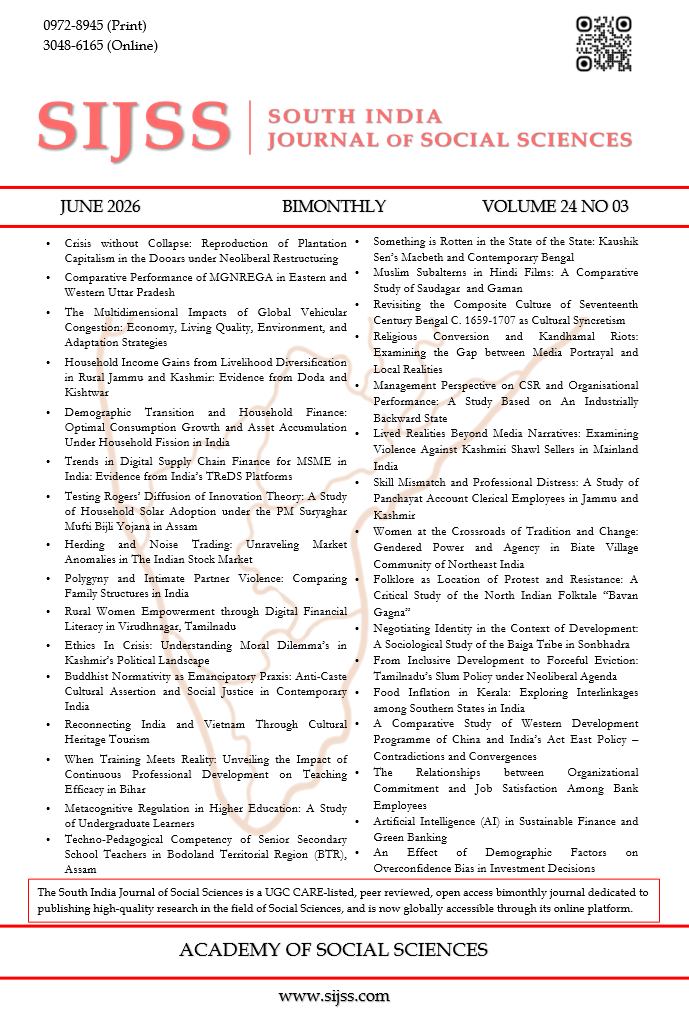
The representation of Muslim subalterns in Hindi films offers a nuanced perspective on the portrayal of marginalised communities in Hindi cinema. Films like "Mughal-e-Azam"(1960) showcased grandeur and nobility, often focusing on the Mughal aristocracy. However, these depictions were far detached from the everyday lives of ordinary Muslims. The presence of Muslim characters, especially from lower socio-economic and cultural backgrounds, remains limited in mainstream cinema, with many stories still untold. Hindi films like Saudagar and Gaman play a critical role in Hindi cinema as they were among the few films which portrayed non-elite Muslim or Muslim Subalterns in the decade of 1970. Muslim subalterns are also known as the Pasmanda community among Muslims.
The research study explores the representation of Muslim subalterns in the late twentieth- century of post-colonial India and traces its trajectories in contemporary public culture in India. It does so by analysing the national and gender politics of Hindi cinema in two Hindi films, Saudagar (Merchant, 1973), directed by Sudhendu Roy, based on the Bengali story Ras by Narendernath Mitra and Gaman (Departure, 1978), directed by Muzaffar Ali and written by Hriday Lani. The article emphasises the gendered biases, female in subaltern households and politics of urban migration in Post-colonial India.
References
1. Ansari, Ghaus (1959), Muslim castes in Uttar Pradesh: A Study in Culture Contact, Lucknow, Ethnographic and Folk Culture Society.
2. Ahmad, I. (2007). Recognition and Entitlement: Muslim Castes Eligible for Inclusion in the Category ‘Scheduled Castes’1. Contemporary Perspectives, 1(2), 89-109.
3. Madan (1974)
4. Momin, A.R. (1989), ‘Islamic Egalitarian vs Social Hierarchy: Reflections on Caste Among Indian Muslims’, Journal of Objective Studies, Vol. 1, nos. 1 &2.
5. Farooqui, Jalil (1989), ‘Caste and Indian Muslims, Journal of Objective Studies, Vol. 1, nos. 1 &2.
6. Ahmad, I. (2007). Recognition and Entitlement: Muslim Castes Eligible for Inclusion in the Category ‘Scheduled Castes’1. Contemporary Perspectives, 1(2), 89-109.
7. Ahmad, I. (2007). Recognition and Entitlement: Muslim Castes Eligible for Inclusion in the Category ‘Scheduled Castes’1. Contemporary Perspectives, 1(2), 89-109.
8. Maggio, J. (2007). “Can the Subaltern Be Heard?”: Political Theory, Translation, Representation, and Gayatri Chakravorty Spivak. Alternatives, 32(4), 419-443. https://doi.org/10.1177/030437540703200403
9. Ramnath, Nandini, Muslim stereotyping in Hindi films: ‘We cannot allow ourselves to forget what constitutes us’, Scroll. in, 20 Sept. 2021. https://scroll.in/reel/1005662/muslim-stereotyping-in-hindi-films-we-cannot-allow-ourselves-to-forget-what-constitutes-us (Accessed on 28.05.2024)
10. A brief note about the film's production details and a summary of its cast have been mentioned. Saudagar: (1973) Producer: Rajshri Production. Written by: Sudhendu Roy, P.L. Santoshi. Direction: Sudhendu Roy. Cast: Nutan, Amitabh Bachchan and Padma Khanna.
11. Gulzar; Govind Nihalani; Saibal Chatterjee (2003). Encyclopaedia of Hindi cinema. Popular Prakashan. p. 337.
12. A brief note about the film's production details and a summary of its cast have been mentioned. Gaman: (1978) Producer: Muzaffar Ali. Written by: Muzaffar Ali, Hriday Lani and Asghar Wajahat. Direction: Muzaffar Ali. Cast: Farooq Shaikh, Smita Patil and Gita Siddharth.
13. Gayatri Chakravorty Spivak, "Can the Subaltern Speak?" in Colonial Discourse and Post-Colonial Theory, eds. P. Williams and L. Chrisman (New York: Columbia University Press, 1992), pp. 66-111.

This work is licensed under a Creative Commons Attribution-NonCommercial-NoDerivatives 4.0 International License.
Copyright (c) 2026 South India Journal of Social Sciences