













Keywords
Mughal
nobles
composite culture
syncretism
How to Cite




Abstract
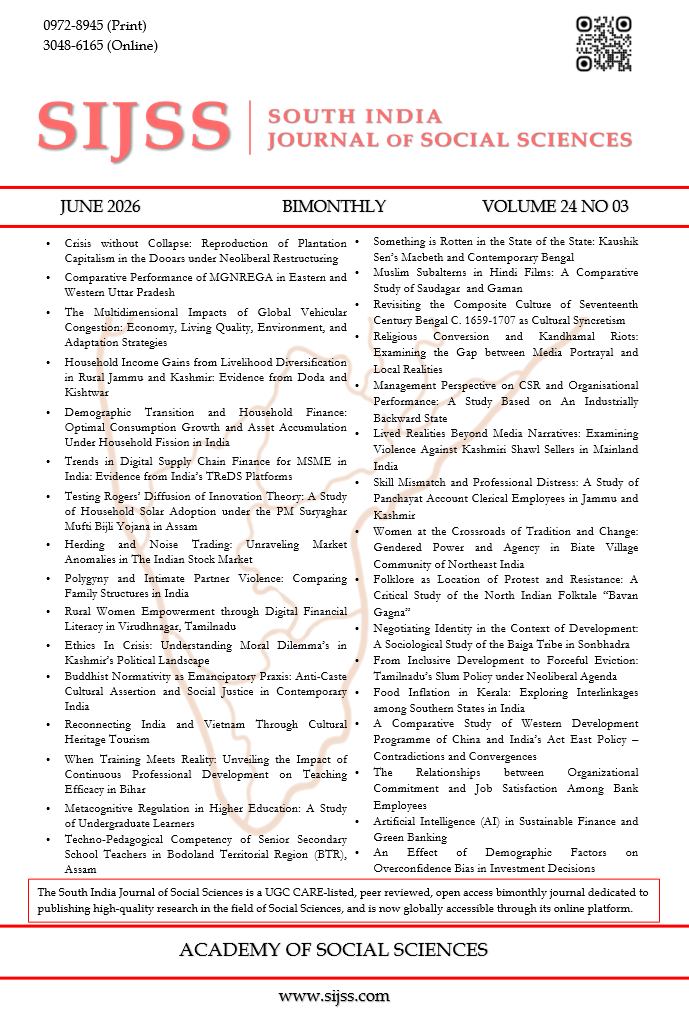
The expansion of the Mughal rule into Bengal coincided with the changing courses of rivers. This culminated in the migration of the population from the west to the east witnessing an expansion of settlement from West Bengal to East Bengal (present Bangladesh). With Mughals, came socio-political and economic and cultural changes which were seen in their royal courts and in Bengal province as well. Even the local masses showed signs of syncretism. Thus, the topographical history of medieval Bengal assumed a different position from the rest of the provinces in the country. Besides contributing significantly to the royal purse, Bengal also synchronised different cultures and its practices, and promoted composite cultures. This diffusion can be seen in their lifestyles, foods and literary works giving an identity to a person and community living in the society. The seventeenth century Bengal society represented itself as a milieu of composite cultures. This paper traces how Mughal nobles and native population in Bengal assimilated each other’s cultures. The aim of the article is not to tread the beaten track but to revisit the cultures of seventeenth century Bengal with the intention to witness the changes or continuity. This study includes the study of the primary sources including the Bengali literature and foreign travelers’ accounts, besides existing modern works.
References
1. Aquil, Raziuddin & Mukherjee, Tilottama (ed.). (2020). An Earthly Paradise Trade, Politics and Culture in Early Modern Bengal. Routledge.
2. Campos, J A. A. (1919). History of the Portuguese in Bengal, Medical Publishers.
3. Chand, Tara (1936). Influence of Islam on Indian Culture. The Indian Press.
4. Chatterjee, Anjali. (2000). Aspects of Medieval Indian Society: Gleanings from Contemporary Literature. Proceedings of the Indian History Congress. 61 (1), 196-241.
5. Chatterjee, Kumkum. (2009). The Cultures of History in Early Modern India Persianization and Mughal Culture in Bengal, Oxford University Press.
6. Chaudhury, Sushil (2013). Identity and Composite Culture: The Bengal Case. Journal of Asiatic Society of Bangladesh (Humanities), 58 (1).
7. Collingham, Lizzie. (2006). Curry: A Tale of Cooks and Conquerors, Oxford University Press.
8. Dasgupta, Asim. (2015). Islam in Bengal: Formative period. Social Scientist, 32(3/4), 30-41; https://doi.org/10.2307/3518022.
9. Eaton, Richard M. (1994). The Rise of Islam and the Bengal Frontier, 1204-1760. Oxford University Press.
10. Eaton, Richard M. (2020). India in the Persianate Age 1000-1765. Penguin.
11. Faẓl, Abu’l. (1869). Ā’īn-i Akbarī, vol.2. Nawal Kishore.
12. Karim, Abdul, “Murshid Quli Khan and his Times”, unpublished thesis submitted for Ph. D Degree, submitted to the School of Oriental and African Studies, The University of London, 1962. [This thesis is published under the title Murshid Quli Khan and his Times, but this book cannot be accessed in the library and therefore, had to refer to the thesis available online]; https://eprints.soas.ac.uk/34101/1/11015917.pdf
13. Lahori, Abdul Hamid. (1868). Bādshāh Nāmah, ed. Kabir Uddin Ahmad & Abdul Rahim, vol.1. Asiatic Society of Bengal.
14. Mahbubul Karim, Khondkar. (1974). The Provinces of Bihar and Bengal under Shahjahan, Asiatic Society of Bangladesh.
15. Majumdar, S. C. (1942). Rivers of the Bengal Delta, University of Calcutta.
16. Manrique, Fray Sebastien. (1926). Travels of Fray Sebastien Manrique (1629-1643), tr. C. E. Luard and S. J. H. Hosten, vol. I, The Hakluyt Society.
17. Mukund, Kabikankan.(1993). Caṇḍīmangal, ed. Sukumar Sen, Sahitya Academy.
18. Nathan, Mirza. (1936). Bahāristān -i –Ghaybī, (1623), trans. M. I. Borah, vol. 1, Narayani Handiqui Historical Institute.
19. Pelsaert, Francisco. (1925). Jahangir’s India: The Remonstrantie. tr. W. H. Moreland & P. Geyl. Cambridge.
20. Pollock, Sheldon. (ed.) (2003). Literary Cultures in History Reconstruction from South Asia. University of California Press.
21. Qureshi, I. H. (1967). The Administration of the Mughul Empire. N.V. Publications.
22. Rā’i Bhanḍārī, Sujān. (1918). Khulāṣatu-t Tawārikh, ed. Zafar Hasan. J & Sons Press
23. Rahman, Md. Shah Noorur, (2001). Hindu-Muslim Relations in Mughal Bengal. Progressive Publishers.
24. Rahman, Md. Shah Noorur. (2018). Religious and Cultural Syncretism in Medieval Bengal, The NEHU Journal, 26 (1), 53-77
25. Raychaudhuri, Tapan. (1953). Bengal Under Akbar and Jahangir: An Introductory Study in Social History. A. Mukherjee & Co.
26. Sabyasachi Bhattacharya, (ed.). (2020). A Comprehensive History of Modern Bengal 1700-1950, vol.1, Primus.
27. Salim, Ghulam Hussain. (1902). Riyāẓu-s Salātīn A History of Bengal. trans. Abdus Salam. Idarah-i Adabiyat Delhi
28. Sen, Amartya. (2006). Identity and Violence The Illusion of Destiny. Penguin Books.
29. Sen, Sukumar. (1940). Banglar Sahityer Itihas, vol. 1. Modern Book Academy.
30. Sen, Sukumar. (1979). History of Bengali Literature, 3rd edition.Sahitya Akademy.
31. Subrahmanyam, Sanjay. (2005). Explorations in Connected History from the Tagus to the Ganges. Oxford University Press.

This work is licensed under a Creative Commons Attribution-NonCommercial-NoDerivatives 4.0 International License.
Copyright (c) 2026 South India Journal of Social Sciences