












Keywords
healthcare access
kashmir
How to Cite




Abstract
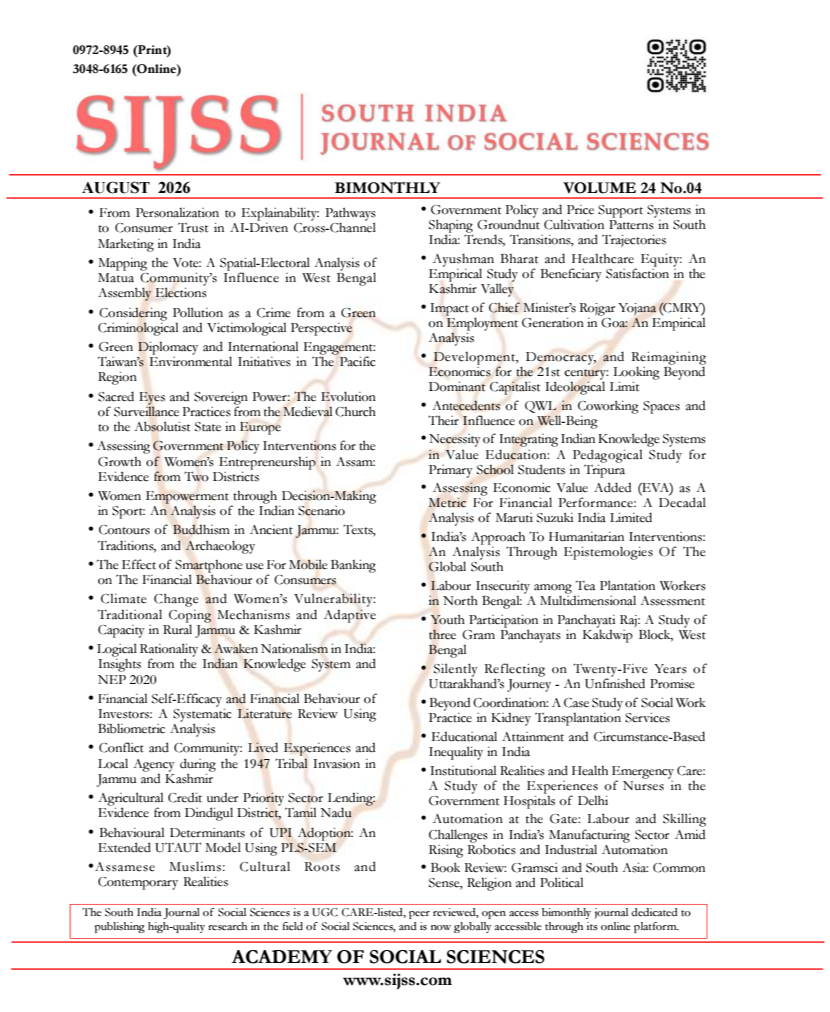
Ayushman Bharat, India’s flagship programme for universal health coverage, seeks to improve access to affordable healthcare through its key component, the Pradhan Mantri Jan Arogya Yojana (AB–PMJAY), which provides cashless hospitalisation for secondary and tertiary care. This study assesses beneficiary satisfaction with AB–PMJAY in the Kashmir Valley, where the scheme functions as a universal entitlement. Using a descriptive and analytical research design, primary data were collected from 500 beneficiaries across ten districts through structured interviews. The analysis examines satisfaction across enrolment processes, hospital access, service delivery, hospitalisation experiences, and perceptions of fairness, while also exploring the operational challenges encountered in implementation. The study concludes that expanding insurance coverage alone is insufficient; sustained improvements in service quality, accessibility, and institutional accountability are critical to ensuring equitable healthcare delivery in geographically and structurally diverse regions like the Kashmir Valley.
References
1. Atkinson, S., & Haran, D. (2005). Individual and district-scale determinants of users’ satisfaction with primary healthcare in developing countries. Social Science & Medicine.
2. Batbaatar, E., Dorjdagva, J., Luvsannyam, A., Savino, M. M., & Amenta, P. (2017). Determinants of patient satisfaction: A systematic review. Perspectives in Public Health, 137(2), 89–101.
3. Donabedian, A. (1988). The quality of care: How can it be assessed? JAMA, 260(12), 1743–1748.
4. Ferreira, D. C., Vieira, I., Pedro, M. I., Caldas, P., & Varela, M. (2023). Patient satisfaction with healthcare services and the techniques used for its assessment: A systematic literature review and a bibliometric analysis. Health care Volume (Issue 4), pages.140-167.
5. Farooq, A., & Ahmad, M. F. (2025). Disparities in healthcare facilities: A district-level study of Jammu and Kashmir. European Economic Letters (EEL), 15(3), 2088–2103.
6. Garg, S., Chowdhury, S., & Sundararaman, T. (2019). Utilization and financial protection for hospital care under publicly funded health insurance. BMC Health Services Research, 19(1), 1–11.
7. Hammer, L. B., Neal, M. B., Newsom, J. T., Brockwood, K. J., & Colton, C. L. (2005). A longitudinal study of the effects of dual-earner couples’ utilization of family-friendly workplace supports on work and family outcomes. Journal of Applied Psychology, 90(4), 799–810.
8. Jenkinson, C., Coulter, A., Bruster, S., Richards, N., & Chandola, T. (2002). Patients’ experiences and satisfaction with health care: Results of a questionnaire study of specific aspects of care. Quality and Safety in Health Care, 11(4), 335–339.
9. Ministry of Health and Family Welfare, Government of India. (2024). 16th Common Review Mission report. National Health Systems Resource Centre.
10. Pascoe, G. C. (1983). Patient satisfaction in primary health care: A literature review and analysis. Evaluation and Program Planning, 6(3–4), 185–197.
11. Xesfingi, S., & Vozikis, A. (2016). Patient satisfaction with the healthcare system: Assessing the impact of socioeconomic and healthcare provision factors. BMC Health Services Research

This work is licensed under a Creative Commons Attribution-NonCommercial-NoDerivatives 4.0 International License.
Copyright (c) 2026 South India Journal of Social Sciences