











Keywords
Environmental Diplomacy
Pacific
How to Cite




Abstract
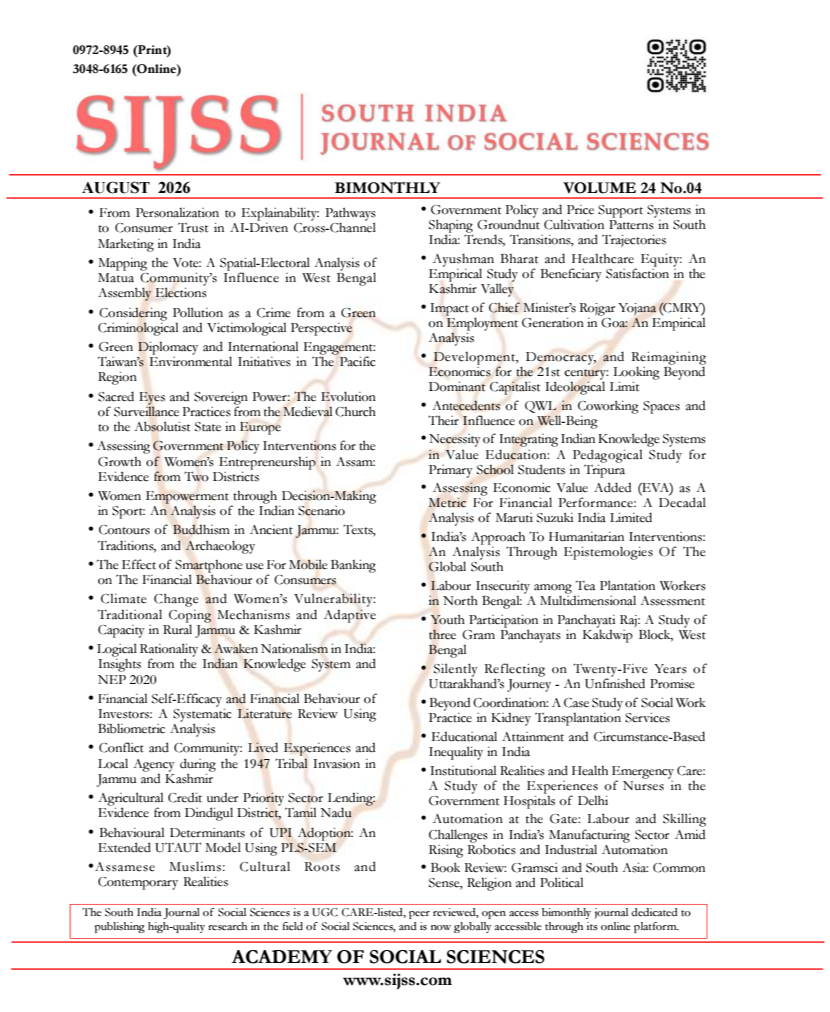
Taiwan's environmental diplomacy in the Pacific has emerged as a critical component of its broader foreign policy, especially in light of its limited formal diplomatic recognition globally. Despite being excluded from major international organizations such as the United Nations and its affiliated environmental frameworks, Taiwan has strategically engaged with Pacific Island nations through bilateral and multilateral environmental cooperation initiatives. This paper explores the nature, scope, and impact of Taiwan's environmental diplomacy focusing on projects in Palau, Tuvalu, Nauru, and the Marshall Islands arguing that it addresses ecological challenges while enhancing Taiwan's visibility, legitimacy, and soft power in the Indo-Pacific. Through programs led by International Cooperation and Development Fund (ICDF) and partnerships with local governments, NGO's and academic institutions, Taiwan has advanced renewable energy development, coastal protection, biodiversity conservation, and disaster preparedness. These efforts align with international climate goals, including the Paris Agreement and UN Sustainable Development Goals, despite Taiwan's formal exclusion from such frameworks. Case studies of renewable energy projects in the Marshall Islands and adaptation strategies in Tuvalu demonstrate both tangible infrastructural benefits and intangible gains in trust and legitimacy. The paper argues that Taiwan's environmental diplomacy not only mitigates ecological risks but also enhances its international standing, counters Chinese influence, and illustrates how marginalized states can leverage sustainability to pursue foreign policy objectives.
References
1. Bock, J., & Parilla, H. (2024, August 21). Why countries abandon Taiwan: Indicators for a diplomatic switch. Global Taiwan Institute. https://globaltaiwan.org/2024/08/why-countries-abandon-taiwan-indicators-for-a-diplomatic-switch/?utm_source=chatgpt.com
2. Bozzato, F. (2017). Taiwan and the Pacific Islands: Exploring the green/blue possibilities. Green Humanities, 2, 127–155. http://www.greehumanities.org
3. Chan, E. (2023). Why size doesn’t matter: The importance of the Pacific Island states to Taiwan’s diplomatic strategy. ANU Undergraduate Research Journal. https://studentjournals.anu.edu.au/index.php/aurj/article/download/880/323
4. Conn, A. (2025, April 9). Taiwan’s diplomatic allies in the Pacific: Navigating China’s growing influence. Indo-Pacific Study Centre. https://www.indo-pacificstudiescenter.org/commentaries/taiwan-pacific-allies-china-influence
5. Fairbank, J. K., Reischauer, E. O., & Craig, A. M. (1998). East Asia: Tradition & transformation. World View Publications.
6. Frost, E. (2024, September 11). Climate action: Taiwan’s underutilized chance at the world stage. Taiwan Insight. https://taiwaninsight.org/2024/09/11/climate-action-taiwans-underutilised-chance-at-the-world-stage/
7. Gallagher, M. (2024, September 20). Taiwan’s indigenous diplomacy: The unweilded sword in the Pacific. PacNet #66. Pacific Forum. https://pacforum.org/publications/pacnet-66-taiwans-indigenous-diplomacy-the-unwielded-sword-in-the-pacific/
8. Huang, J. (2025, January 17). Climate diplomacy in the Pacific (Editorial). Taipei Times. https://www.taipeitimes.com/News/editorials/archives/2025/01/17/2003830337
9. Joy, A. (2023, May 31). China, Taiwan and the One China Principle. Electronic Journal of Social and Strategic Studies, 4(1), 40–63. https://doi.org/10.47362/EJSSS.2023.4103
10. Mabon, L. (2023, February 13). How does Taiwan participate in international climate change negotiations? Sustainability at the Open University. https://university.open.ac.uk/sustainability/news/how-does-taiwan-participate-international-climate-change-negotiations
11. Morgan, W., Carter, S. G., & Manoa, F. (2024). Leading from the frontline: A history of Pacific climate diplomacy. The Journal of Pacific History, 59(3), 353–374. https://doi.org/10.1080/00223344.2024.2360093
12. Pant, H. V. (2021, October 20). Taiwan and the Indo-Pacific. Observer Research Foundation. https://www.orfonline.org/research/taiwan-and-the-indo-pacific
13. Parlevliet, A. (2024, July 17). Support threefold: Taiwan’s Pacific Island allies. New Perspectives on Asia—Centre for Strategic and International Studies. https://www.csis.org/blogs/new-perspectives-asia/support-threefold-taiwans-pacific-island-allies
14. Rigger, S. (2010). Taiwan. In W. A. Joseph (Ed.), Politics in China: An Introduction (pp. 368–374). Oxford University Press.
15. Tai, T. (2024, November 18). How Taiwan can help in the Pacific (Editorial). Taipei Times. https://www.taipeitimes.com/News/editorials/archives/2024/11/18/2003827059
16. The Australian National University. (n.d.). ANU Student Journals. https://studentjournals.anu.edu.au/
17. Tsaiying Lu, Lin, M.-H., Chang, C.-Y., Frost, E., & Yang, Y.-P. (2024, November 1). Taiwan’s role in driving climate action and regional sustainability. The Diplomat. https://thediplomat.com/2024/11/taiwans-role-in-driving-climate-action-and-regional-sustainability/
18. Tseng, H. Y. K., Kao, S. M., & Tseng, H. S. (2023). Rationalizing Taiwan’s climate action based on oceans: Ineffective governance, aspiring international participation, unrealized universal values, and a new window of blue carbon ecosystem measure. Frontiers in Marine Science, 10, Article 1268122. https://doi.org/10.3389/fmars.2023.1268122
19. Wong, N. W. M. (2024). Exploring the motivations behind environmental volunteering and the development of environmental citizenship in Taiwan. Social Sciences & Humanities Open, 10, Article 100986. https://doi.org/10.1016/j.ssaHO.2024.100986

This work is licensed under a Creative Commons Attribution-NonCommercial-NoDerivatives 4.0 International License.
Copyright (c) 2026 South India Journal of Social Sciences